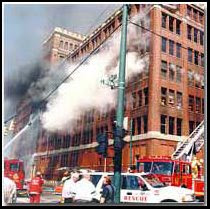
Honoring the Fire and Rescue Service - Springfield, Ohio and Beyond - On Web Since 2005
Fire Buffs promote the general welfare of the fire and rescue service and protect its heritage and history. Famous Fire Buffs through the years include New York Fire Surgeon Harry Archer, Boston Pops Conductor Arthur Fiedler, New York Mayor Fiorello LaGuardia and - legend has it - President George Washington.
Tuesday, September 06, 2011
EMERGENCY SQUAD - 1953
Friday, January 21, 2011
CROWELL-COLLIER - 2009
Thursday, September 09, 2010
FEMALE FIREFIGHTER
By Valerie Lough
Springfield News-Sun
Sept. 8, 2010
SPRINGFIELD — The first time Diane Arbogast saw a fire engine, it was the day she reported for training at a new job — as a firefighter.
And, all those doo dads on the engine’s pump panel looked pretty intimidating.
“You look at something like that the first time and go ... ‘Ok,’ ” said Arbogast. Twenty-five years later, Arbogast, the first female firefighter at the Springfield Fire Division, retired Wednesday, Sept. 8.
But, as a child, putting out fires wasn’t her dream. She thought she might be a nurse
“I’m not a nurse, but I do take care of people,” she said. Arbogast found her way to the Springfield Fire Division in search of a better job with good benefits.
In other attempts to get a solid job in 1985, some prospective employers told Arbogast flat-out that they preferred to hire a man for the job.
But when she joined the fire division that same year, the climate was much more welcoming, she said. “All the guys were always just super,” she said.
Fellow firefighter John Sells said Arbogast’s nurturing instinct made her a natural in the job. “I think a lot of people will describe her as motherly,” said Sells. “I’ve never seen her get mad.”
Arbogast plans to continue with her second job in the emergency room at Springfield Medical Center and enjoying her eight grandchildren and great grandchild.
Her voice cracked as she spoke of what she would miss the most about her job — the people she worked with.
“It’s like a big family ... they’ve become my second family,” she said.
Tuesday, July 06, 2010
Friday, June 11, 2010
WINTER'S FIRE - 1892
On April 12, 1892, fire gutted Winter's Art Lithographing Co. in Springfield, Ohio - destroying materials printed for the Chicago World's Fair of 1893, according to the next day's The New York Times.
"Before the Fire Department could arrive the entire three stories were enveloped in flames," the Times reported. "The company had contracted for all the World's Fair lithographing, and part of the orginial stones for the World's Fair work were destroyed."
The fire orginated in a room of oils and inks, "supposedly by spontaneous combustion," and "the heavy machinery was ruined by dropping to the basement," the newspaper reported. It said "the building is a total wreck."
WOODLAWN HALL - 1928
On May 15, 1928, fire swept the Woodlawn Hall womens' dormitory at Wittenberg College, killing Hilda Sipes, 20, of Shelby, Ohio, according to a dispatch from the Associated Press.
Other women were injured jumping from windows early that Tuesday morning, the campus newspaper, The Torch, reported two days later.
Over the years, the tragedy contributed to ghost stories about Woodlawn Hall.
Ms. Sipes died in a lavatory across from her room, No. 11.
Firefighters located her body, clad in a nightgown, in a bathroom "stretched flat on the floor between the bathtub and the wall," said Fire Captain Ed Garrity of the Central Engine House, quoted by the Springfield Daily News.
The fire was discovered by Lilly Myers, house mother for the 20 residents, at about 2 a.m., according to The Torch.
The Associated Press identified three of the injured students as Alice Olde of Detroit, Helen McClain of Troy, Ohio, and Marie Schneider of Indianapolis.
The AP also reported: "More of the girls might have been trapped in bed had not most of them remained awake longer than usual to listen to a midnight serenade of a campus fraternity."
The AP dispatch was published in the May 16, 1928 edition of the Hartford Courant newspaper of Hartford, Connecticut. The headline of the story on page 6 of the newspaper read: "Co-Ed Killed in Dormitory Fire in Ohio."
The AP reporter identified the dormitory as "Woodland Hall."
Wednesday, January 13, 2010
FIREMEN'S PICNIC
Friday, December 11, 2009
OLD ENGINE 2
Wednesday, December 02, 2009
CHIEF HUFFMAN
Harry Huffman was promoted to platoon chief on Jan. 1, 1947. He was appointed to the fire division in 1928 and retired on April 1, 1949. At the time, the fire division fielded two platoon chiefs, who acted as shift commanders. In the overall chain of command, they answered to the fire chief and the assistant fire chief.
According to a newspaper article on his retirement, Huffman's pension paid $155 a month or half his regular pay. Huffman was promoted to lieutenant in July 1935 and captain in August 1938.
This photo was provided by the chief's family.
His father and brother were also Springfield firefighters.
OLD ENGINE HOUSE 5
Wednesday, November 18, 2009
COAL FIRE - 1917
The Springfield Tire Fire always burns in the hometown of "The Simpsons" television series. In 1917, a coal fire smoldered for weeks in Springfield, Ohio. "Springfield firemen resorted to the use of steam shovels to help fight fire in a 100,000 ton coal pile in the Big Four railroad yards, burning since Aug. 1," according to the Mahoning Dispatch of Canfield, Ohio, on Sept. 14, 1917. Friday, November 13, 2009
FIRE STATIONS - 1907
Fire Chief — Samuel F. Hunter.
Superintendent of Telegraph — Michael M. Duffy.
Central Steam Fire Company No. 1 — West side of South Fountain Avenue, between Jefferson and Washing ton; H. M. Rankin, captain.
Engine Company No. 2 — East side of North Factory Street, between Columbia and North; C. M. Moffett, captain.
Engine Company No. 4 — Lagonda Avenue, between C, C, C. & St. L. Railroad and Florence; J. Edward Bryant, captain.
Engine Company No. 6 — Southeast corner Mound and Glenn Avenue; E. J. Perkins, captain.
Chemical Engine Company — West side of South Yellow Springs, between Pleasant and Dibert Avenue; William Fanning, captain.
Hook and Ladder Company No. 1 — West side of South Fountain Avenue, between Jefferson and Washington.
Hook and Ladder Company No. 3 — Northwest corner Clifton and Boler; H. T. Evans, captain.
Southern Steam Fire Company No. 3 — Northwest corner Clifton and Boler ; H. T. Evans, captain.
Hose Company No. 4 — East side Lagonda Avenue, between C, C, C. & St. L. Railroad and Florence.
Hose Company No. 5 — South side Main, near Park ; L. L. Metcalf , captain.
Hose Company No. 6 — Southeast corner Mound and Glenn; E. J. Perkins, captain.
Hose Company No. 7 — South side Cecil, between Fountain Avenue and Limestone; Pat H. Lawler, captain.
Hose Company No. 8 — West side South Yellow Springs, between Pleasant and Dibert Avenue; William Fanning, captain.
SOURCE: 20th Century History of Springfield , and Clark County, Ohio and Representative Citizens. Edited and compiled by Hon. William M. Rockel, Springfield, Ohio - 1908.
TWO PLATOONS
"The chief is continuously on duty; his entire time is given to the city, and all firemen sleep with their ears attuned to telephone calls, responding as quickly at night as to day time alarms," according to Prince's book.
"Under the two-platoon system firemen have home privileges impossible under previous conditions ; they have opportunity of knowing their families and sharing in home pleasures appreciated by all of them."
Today, the Fire Division employs a three-platoon system.
Thursday, November 12, 2009
GOOD SAMARITANS - 2007 & 2009
Tuesday, November 03, 2009
HAMMA SEMINARY - 1900
According to an article in the next day's Times newspaper in Washington, D.C., firefighters rescued three students.
All the others were at home for the holidays. The blaze started in a furnace "and by the time the students noticed it the chapel on the first floor was in a blaze," the Times newpaper said. "Efforts to put it out with buckets were fruitless, as the smoke was suffocating."
Underscoring the rapid spread of the flames, the newspaper said Oliver McWilliams, of Montgomery, Pennsylvania, "tried to get out of his room, but was forced back by the smoke."
John Sweeter, of Curlsville, Pennsylvania, "was rescued from a second-story window."
C.A. Hackenburg, of Pittsburgh, "escaped by crawling out on the rear part, where the firemen took him down."
The seminary - located on the grounds of Wittenberg University, then called Wittenberg College - was rebuilt in 1901.
MYERS HALL - 1902
Springfield firefighters saved Myers Hall at Wittenberg University from a prank gone awry in the early 20th Century, according to the Spring 2001 edition of Wittenberg Magazine.
The late Rev. Willard Hackenberg, Class of 1901, recalled that two students set fire to coal bins at the rear of the dorm:
“What a fire that was! Think of the many tons of coal that were burned. ... The Springfield Fire Department came with great force, but because the water pressure was so low, all the firemen could do was protect the dorm.
"They had to allow the coal and the bins to burn, using all the water on hand to keep the very hot flames from reaching the most important building.” The article didn't mention the date of the fire.
Tuesday, July 21, 2009
Thursday, May 28, 2009
RUNS & WORKERS - PART 3
- A search of Google's newspaper archives turned up a brief wire dispatch in The Age, an Australian daily from Nov. 13, 1961. It read:``Three children perished last night when fire swept through their third-floor flat in Springfield, Ohio. Their mother, with her six-month-old son, was visiting friends in a second-floor flat at the time. Firemen found the woman, Mrs. Elisa Duheart, screaming at the door to her blazing flat, attempting in vain to batter it down to rescue her children.''
- On Sept. 7, 1956, an explosion caused the collapse of a new addition to the Donnelsville School, near Springfield, according to the Associated Press. Emma Blackburn, 62, a teacher, suffered rib and wrist fractures. The explosion happened about an hour after school was dismissed for the day, the AP reported. The addition opened four days earlier.
- On Jan. 11, 1976, flames engulfed a house near Springfield, killing an elderly man and his two sisters, according to United Press International. Fire crews located the bodies of John Shaw, 80, Nattie Shaw, 74 and Ruth Shaw, 59 in the debris, according to Hustead fire officials quoted by UPI.
They called it ``America's long hot summer.'' In July 1967, rioting in Detroit led to disturbances in other cities. ``Springfield, Ohio, reported its first racial incidents, with rock throwing and tossing of fire bombs,'' according to the Free-Lance Star of Fredericksburg, Virginia on July 28, 1967. Trouble was also reported in the Ohio cities of Toldeo and Lorain.
- SPRINGFIELD, Ohio (UPI) - Firemen say four children playing with matches behind the Lynn Hockenson Co. here accidentally touched off a three alarm fire that swept through the cardboard box producing plant, causing an estimated $40,000 damage. [The Bryan Times, Bryan, Ohio, April 12, 1971]
Friday, May 15, 2009
CHILD CALLS 911
On May 2, 1990, a three-year-old boy named Tyler Wolf dialed 911 after his mother fell unconscious in their home at 817 East McCreight Avenue in Springfield, Ohio."He knows that he helped mommy and he called the squad for mommy," said his mother, Lori Wolf, who was quoted by The Dayton Daily News. "We're very proud of him."
The boy's father - employed by a private ambulance company - was at work. The parents taught Tyler how to dial 911.
Following is a transcript - from Dayton Daily News archives - of Tyler, fire dispatchers Rick Williams and David Storer, and police dispatcher Ann Eubanks:
WILLIAMS: "What's wrong, son?"
TYLER: "Mommy fall."
WILLIAMS: "Did mommy fall down?"
TYLER: "Yeah."
WILLIAMS: "What's your name?"
EUBANKS: "Is it Tyler?"
TYLER: "Yeah."
EUBANKS: "How old are you?"
TYLER: "Three."
EUBANKS: "And your mommy's right there and she fell down?"
TYLER: "Yeah."
WILLIAMS: "Is his daddy there?"
TYLER: "No. At work."
WILLIAMS: "Did his mom ask him to call?"
WILLIAMS: "Tyler, you stay here on the phone, OK?"
(IN THE BACKGROUND: Williams then asks fellow fire dispatcher Storer to pick up the call while he sends an engine and emergency squad to the home.)
STORER: "Hi, Tyler. How are you?
WILLIAMS: "Tyler, go ahead and talk to this man for a minute, OK?"
TYLER: "Hi."
STORER: "Hi. We're going to send the emergency squad and an engine out there, and they'll talk to you and take care of your situation, OK?"
TYLER: "No. My dad not going to be here."
STORER: "Why isn't he?"
TYLER: "Because he's working 24."
STORER: "Just your mother's there?"
TYLER: "Yeah. (Unintelligible)."
STORER: "Tyler, stay here on the phone, OK? We want to keep talking to you. How old are you, Tyler? What are you, about seven?"
TYLER: "Mommy! Mommy!"
STORER: "Is your front door unlocked so that the firemen can come in?"
TYLER: "Yeah. No. It's locked."
STORER: "Do you know how to unlock it so that the firemen can help your mom?"
TYLER: "Yeah."
STORER: "OK, because the firemen are on their way up there, OK?"
TYLER: "Mommy! Mommy! Bye."
STORER: "Don't hang up now."
WILLIAMS comes back on the line and says, "Hey, Tyler. What's your mommy doing now?"
TYLER: "Laying down."
WILLIAMS: "Did she hurt her head or something? Did she bump her head?"
TYLER: "No."
STORER comes back on the line and asks, "Are her eyes closed?"
TYLER: "Yeah."
STORER: "OK. We're going to need you to unlock the front door for the firemen, OK?"
TYLER: "OK."
WILLIAMS: "Don't do it right now. We'll stay on the phone with you until the firemen get there, OK? They'll be there in just a little bit. It doesn't take them very long."
TYLER: "Can I put the phone on the chair?"
WILLIAMS: "No. Don't put the phone on the chair right now. You just stand there and hold it. Are you standing there holding the phone?"
TYLER: "No. I'm sitting down."
WILLIAMS: "You're sitting down. OK. Is your last name Wolf?"
TYLER: "Yeah."
WILLIAMS: "Where's your dad? Is he at work?"
TYLER: "Yeah. He's working 24 today. His name Barry Wolf."
WILLIAMS: "His name is Barry Wolf and he's working 24? Do you know where he works? Do you know what company he works at?"
TYLER: "He don't work at company no more. He work at Med Trans."
WILLIAMS: "He works at Med Trans. Hey, Tyler. Go over and open the front. I want you to go over and open the front door, then come get back on the phone."
TYLER: "OK."
(IN THE BACKGROUND: There are three knocks on the door. Tyler asks, "Yeah. Who is it?" He unlocks the door after the firefighters identify themselves and ask him to show them where his mother is. One firefighter then picks up the phone.)
FIREFIGHTER: "Hey Rick. You there?"
WILLIAMS: "Yeah."
FIREFIGHTER: "OK, we're here, bud."
WILLIAMS: "Is it real?"
FIREFIGHTER: "Yeah. Bye."
WESTERN SCHOOL - 1954
On Jan. 4, 1954, a general alarm fire swept the 99-year-old Western Grade School at West Main and Yellow Spring streets.
Eight teachers and 275 pupils were safely evacuated by the time firefighters arrived, demonstrating the value of regular fire drills.
The Springfield Daily News reported that when the alarm sounded teachers ``did not know it was a real fire'' and ``headed their charges out of the building before they realized the building was aflame.''
Coincidentally, an earlier school by the same name was destroyed by fire in February 1858.
Four years later, a fire at the Our Lady of Angels School in Chicago claimed about 100 lives, leading to sweeping changes in school fire safety across the nation.
TREMONT CITYLODD - 1963
Friday, March 20, 2009
CHITTENDEN HOTEL - 1893
Thursday, March 19, 2009
OX TEAM - 1800s
Tuesday, March 17, 2009
Tuesday, October 28, 2008
GAMEWELL TELEGRAPH

When a box was pulled, a spring-loaded wheel transmitted its number and the bells at the city's fire stations clanged out the location.
Firefighters also used Gamewell boxes to request assistance - second alarm, third alarm, etc. - and transmit ``out tap'' signals declaring a fire under control.
On Sept. 23, 1915, Superintendent of Fire Alarm Lawrence Bosley, 45, was fatally injured in fall from a telegraph pole on Main Street, just west of Burnett Road, while doing line maintenance.
Beers' History of Clark County - 1881
6 The Western engine house.
7 Corner of High and Spring streets.
8 Central engine house.
9 Corner Lagonda avenue and Nelson street.
12 Corner Monroe and Spring streets.
13 Corner North and Limestone streets.
14 Corner Chestnut avenue and Limestone street.
15 Corner Main and Limestone streets.
16 Corner Ferncliff avenue and Market street.
17 Corner Main and Center streets. 18 Corner Center street and Obenchain alley.
21 At Spangenberger House. East Main street.
23 Corner Lagonda avenue and Main street.
24 Corner York and High streets.
25 Corner Tavlor and Pleasant streets.
26 Corner Linden avenue and Clifton street.
27 Corner Pleasant and East streets.
28 Corner High street and East streets.
29 Corner High and Forrest avenue.
31 Corner Hizer and Limestone streets.
32 Corner Center and Pleasant streets.
34 Corner Factory and Washington streets.
35 Corner Mechanic and Pleasant streets.
41 Corner Yellow Springs and Pleasant streets.
42 Corner Yellow Springs and Main streets.
43 Corner Clifton avenue and Liberty street.
51 Corner North and Plum streets.
52 Carner Main and Light streets.
53 Corner Main and Isabella streets.
61 Champion Machine Company's shops, Monroe street.
Tuesday, August 26, 2008
ELKS CLUB - 1939
Monday, August 25, 2008
BORDEN DAIRY - 1958
On Feb. 20, 1958, a general alarm fire started by a welder's torch gutted the old Borden Dairy at 125 North Fountain Avenue.
``Two minutes after the blaze was reported, thick clouds of brownish yellow smoke poured from the building,'' The Springfield Daily News reported.
Fire Chief Willard Compton credited a dairy employee with preventing the flames from spreading.
Carl Newberry closed a door between the storage department and the cheese department and contained the flames.
Milk cartons coated with paraffin fueled the flames, making for a smokey, slippery mess.
After the fire, the pile of debris outside the dairy rose to the second floor.
Engine Co. 1 had just returned to the Central Engine House from a run to the Hume Hotel when the alarm was transmitted for the dairy, according to a 1978 history of the fire division, ``From Buckets to Diesels'' by Captain Calvin Roberds.
ZIMMERMAN FIRE - 1953
On March 10, 1953, a general alarm fire gutted the five-story Zimmerman Building at Limestone and Main streets in downtown Springfield - but a lone lightbulb inside the structure refused to go out.
The blaze burned for more than five hours. It started in the basement and traveled up a dumb waiter shaft to the top floor.
``Although the Ohio Edison Company cut all electric service to the building one light bulb continued to remain lit all through the fire and stayed lit until the upper three stories were removed,'' Fire Captain Calvin Roberds wrote in his 1978 history book From Buckets to Diesels. ``The source of the power was never found.''
Rex Miller, who worked at Pat Finnigan's tavern, pulled the alarm box at the interestion at 2:52 a.m., The Springfield Daily News reported. The second alarm followed at 2:58 a.m. and the general alarm at 3:17 a.m.
``I heard something like a shot being fired or an explosion in the basement,'' Miller told the newspaper. ``The next thing I knew was flames flaring from the basement.''
Hazel Patton, the lone occupant of the office building, fled on a fire escape. Springfield Fire Chief Willard Compton directed the fire fighting and ``practically all men and apparatus from the city department were pressed into service,'' the Daily News said.
B-29 ACCIDENT - 1946
According to newspaper accounts, the B-29 - which had just set a speed record - was on approach to Wright Field near Dayton when the right outboard propeller broke loose.
After striking the aircraft, the propeller plunged into a field on Leffel Lane. Another part buried itself in a yard at 335 West Euclid Avenue. A piece of aluminum casing struck the porch of a house at 315 Highview Avenue. Part of cylinder landed in a yard on Magnolia Boulevard.
No one was injured on the ground and the aircraft landed safely.
Sunday, August 24, 2008
LUMBER YARD FIRE - 1939
Early on May 20, 1939, a general alarm fire swept the yard and buildings at the Clark County Lumber Co. and illuminated the night sky.
``All available equipment of the Springfield fire department was enlisted in the fruitless battle against the scorching flames,'' the Springfield Daily News reported. Train traffic on the New York Central Lines was halted.
Fire Captain Earl Hickman was treated at the yard - located at 1620-1734 West Main Street - for a hand injury and returned to his duties, Fire Chief Grover Frock said.
At the height of the catastrophe, flames leaped more than 100 feet into the sky and threatened adjacent homes and buildings.
Brands fell on a number of properties on the north side of the city and set a fire that destroyed a grain elevator at 1800-24 Main Street. Sparks also ignited a small fire at the Wilson Furniture Service at 1719 West Main Street as well as grass fires.
Utility poles and wires also burned.
According to news accounts, the lumber yard blaze started in Building B, which contained linoleum, insulating material, composition shingles and kitchen cabinets and spread to Building A, which contained the paint department. In all, five buildings were lost.
Tuesday, July 22, 2008
DOUBLE DUTY - 2005
Photo: IAFF Local 333 web site
On May 5, 2005, the Springfield Fire-Rescue Division battled a pair of serious fires.
The first blaze swept an abandoned building on the northern edge of Snyder Park - apparently the former Bullock Garages, according to the Springfield News-Sun.
``It had a pretty good start on us before we got here,” Fire Chief Mike Beers told the newspaper, with firefighters stretching more than 1,000 feet of hose over railroad tracks and through woods to the nearest hydrant.
The second fire gutted a home at 2712 Berger Ave. Amber Griffith and her 4-year-old son escaped - and also saved their cat, according to the News-Sun.
Friday, June 20, 2008
RUNS & WORKERS - PART 2
- On Christmas morning 2004, Lt. Doug Buffenbarger of Rescue 1 plunged into the basement of a duplex at 805-807 Innisfallen Avenue after the first floor collapsed. Buffenbarger survived the fall, suffering only minor injuries, according to the Springfield News-Sun.
- On Sept. 18, 2007, a flashover ripped through a vacant house as crews advanced hose lines inside the dwelling. Battalion Chief Marc Lloyd said none of the firefighters were injured in the incident in the 100-block of Shaffer Street, according to WHIO-TV.
- On Jan. 30, 2008, high levels of carbon monoxide were detected at a home on South Limestone Street, sending six adults and two children to Springfield Regional Medical Center for testing, the Springfield News-Sun reported. The house tested at 50 ppm of carbon monoxide. "We walked in the building and our monitors went into alarm immediately," Springfield Fire Division Lt. Doug Buffenbarger told the newspaper. "Anything greater than 35 (ppms), we have them evacuate immediately."
- On Jan. 25, 2006, fire swept a house at 623 West North Street, killing Patrick A. Wright, 56, his dog and his three cats. "I looked out and saw the whole front room on fire," neighbor Sandy Gootee told the Springfield News-Sun. "I thought, 'Oh my God,' so I called 911 because all I could think about was him being in there." Assistant Fire Chief Nick Heimlich said some of the doors were bolted shut, according to the newspaper.
- On Nov. 12, 2003, winds damaged the roof of the Dole Fresh Vegetables packaging plant in Springfield, snapping an ammonia line and forcing the evacuation of 150 workers, said Mike Doan, assistant fire chief. Two people were hospitalized, according to the Cincinnati Enquirer.
Wednesday, May 14, 2008
SPECIAL UNITS - HAZMAT 1, FOAM 11
Photo: Springfield Fire-Rescue DivisionHazmat 1 went in service in June 2005, serving both the City of Springfield and communities in Clark County. The special unit is based at Fire Station No. 1 on North Fountain Avenue. It was built by Sutphen Corp. plants in Springfield and Dublin, Ohio, and financed by a federal government grant. Hazmat 1 is owned by the Clark County Commissioners and staffed by Springfield firefighters.
Photo: Springfield Fire-Rescue Division
Foam 11 of the Springfield Fire Division was placed in service in the mid-1970s at Fire Station No. 1. The 750-gpm pumper was assigned to Engine Co. 3 prior to its conversion to a foam wagon. The rear hose bed was modified with the addition of a foam nozzle and high-expansion foam equipment. Foam 11, on occasion, responded to fires at the International Steel Wool Co. plant on the city's west side.
Thursday, April 10, 2008
`BUCKETS TO DIESELS'
Crowell-Collier General Alarm - 1999
Springfield, seat of Clark County, Ohio, is located between Dayton (to the west) and Columbus (to the east).
The Springfield Fire Rescue Division is a career fire department that protects the City of Springfield, Ohio, which is located along Interstate 70 and the old ``National Road'' in West Central Ohio. The city is the seat of Clark County.
The fire and rescue service - responsible for emergency medical care, firefighting, technical rescue and hazardous materials response - fields 10 companies operating from seven stations in three platoons (or shifts).
The shifts (A Unit, B Unit and C Unit) work ``24 hours on, 48 hours off.'' Each platoon is commanded by a battalion chief - a rank previously called "platoon commander" or "platoon chief."
Crews of the city's ``combination companies'' respond with either an engine or medic unit depending on the nature of the call - fire, medical, etc. The city also operates a rescue engine, three aerial ladders, a Hazmat unit and a technical rescue unit. An engine and medic unit are also held in reserve.
Typical on-duty staffing is three firefighters per vehicle - or about 30 firefighters, paramedics and officers - per shift. Combination companies are led by lieutenants. The rescue is also led by a lieutenant. Truck companies (the aerial ladders) are led by captains.
The fire rescue division is commanded by the Fire Chief, who is supported by two assistant chiefs and a headquarters staff of uniformed and civilian personnel.
The volunteers of the Box 27 Associates club assist the fire division at major fires and emergencies. The volunteers operate a light and air wagon and a mobile canteen.
Township fire departments protect the rest of Clark County and provide mutual aid to the city, and the Ohio Air National Guard operates a fire and rescue station at the municipal airport.
Finances
The story of the Springfield Fire Rescue Division is one of dedicated service and innovation against a backdrop of difficult municipal finances and chronic personnel shortages.
Station No. 2 closed during the Great Depression, and Station No. 9 closed in 1974 as the city's manufacturing base started to shrink.
In the early 1990s, three of the city's fire stations had only two firefighters assigned to each shift, and by mid-decade, the engine company at Station No. 1 was disbanded.
On average, the city's fire engines carried larger crews before the Great Depression of the 1930s, though at that time firefighters also worked longer hours.
The situation has since been reversed. A new policy of billing for ambulance services is providing more money for the recruitment of firefighters and paramedics.
Roberds Book
The fire division was the subject of the 1978 book ``From Buckets to Diesels'' by Springfield Fire Captain Calvin Roberds, who began his career as an auxiliary fireman during World War II. He retired in 1985, having attained the rank of platoon commander.
Roberds, who took great pride in his work as a fire service historian, died in 1995 at the age of 72.
The firefighters' union (IAFF Local 333) and Box 27 Associates helped raise funds for the publication of Roberds' book.
The Springfield Fire Journal is intended to serve as a 21st Century extension of Captain Roberds' comprehensive work. Besides adding new features to the Fire Journal, your editor regularly updates existing articles.
Suggestions are welcomed at wb2kqg@arrl.net
City Heritage
Springfield, established in 1799 by James Demint and migrant Kentuckians, evolved into a major industrial center in the 19th and 20th centuries.
In the 1800s, it led the U.S. in production of agricultural equipment. In the early 1900s, the city's factories produced a variety of autos, including the Bramwell, Brenning, Foos, Frayer-Miller, Kelly Steam, Russell-Springfield and Westcott, according to the Ohio Historical Society.
As the community evolved, fire protection evolved too - from bucket brigades, to volunteer companies and minute men, to a paid fire department to today's fire-rescue service.
Prevention vs Suppression
In the fire service, community safety is Priority No .1.
In his book, Roberds observed:
``Considering the primary mission of the fire service - fire prevention - the fire division has done its most effective work when the engines are in the engine houses. Yet the average citizen is apt to feel that engines not in use are not needed. Conversely, when the firefighters and engines are hard at work on a major fire, the first mission of the fire service has already been lost.''
Paramedics
Since the fire division fielded its first "Emergency Squad" in 1949, its role as first responder to medical emergencies has increased, with medical runs accounting for more than 80 percent of ALL the division's annual runs.
The formal name of the agency was changed to the Springfield Fire Rescue Division in the 1990s to reflect its wider role in the community.
In the annual report for 2004, Springfield Fire Chief Mike Beers reported that three decades after the establishment of the paramedic program - during the tenure of Fire Chief Frank Trempe - more than 80 percent of the city's firefighters are certified to provide advanced life support.
``Frank Trempe was my first fire chief, and he is oftentimes credited with having the vision to embrace the paramedic program that has led to our having the ability today to provide emergency medical services second to none,'' Beers wrote.
ARCADE HOTEL - 1894

On Feb. 19, 1894, fire swept the downtown Arcade Hotel.
Flames started in the basement ``Kindling Room,'' where coal and other fuels were stored - and ascended the elevator shaft.
Fire Chief Ed Simpson ordered a general alarm to save the hotel.
``So quickly did the smoke cover the entire building that the women attaches of the hotel and in the dining room were compelled to escape from the windows and over the roof,'' The Springfield Weekly Republic reported Feb. 22.
The flames - discovered at 10:15 a.m. - ``spread from the east side to the west side of the hotel throughout all floors, and began eating their way through the hallways on the west side, where the guest chambers are,'' the Republic said.
``The fight became bitter here to prevent the spread of the flames, for if they could pass this point the entire block to High Street would probably be consumed,'' the newspaper said.
By 2 p.m., though, Simpson said the fire was under control.
OFFICE OF FIRE CHIEF
Photo: Fire Division web site
On May 7, 2004, J. Mike Beers (right), who served as chief of the Springfield Fire Rescue Division from 2000-2010, received an Ohio Fire Executive diploma from Stan Crosley, president of the Ohio Fire Chiefs' Association at Ohio State University.
James Cushman 1855 (Volunteer)
Abram Ludlow 1856-1857 (Volunteer)
Jeremiah Klinefelter 1857-1859 (Volunteer)
William Blakeny 1859-1865 (Volunteer)
Abram Ludlow 1865-1871
Robert King 1891-1879
J. Christie Holloway 1879-1882
William Moore Jr. 1882-1884
Ed Simpson 1884-1895
George Follrath, 1895-1904
Samuel Hunter, 1904-1928 (Hired from outside fire division)
Louis Locher, 1928-1934
Grover Frock, 1934-1952
Willard Compton, 1952-1963
John Gnau, 1963-1970
Frank Trempe Jr. 1970-1980
William Edgington 1980-1983
William Casey 1984-1989 (Served as acting chief before appointment. Also acted as temporary city manager.)
Donald Lee 1992-1997 (Served as acting chief before appointment )
Frank Montes De Oca Jr. 1997-2000 (Hired from outside fire division)
J. Mike Beers 2000-2010
Nicholas Heimlich 2010-present
Over the years, three of Springfield's fire chiefs served as presidents of the Ohio Fire Chiefs' Association: 1919-21 Chief Samuel F. Hunter, 1937-38 Chief Grover L. Frock, 1958-59
Chief Willard C. Compton.
The chief's association presented its Distinguished Service Award to retired Springfield Fire Chief Frank Trempe in 1983. The members of Box 27 Associates received the Distinguished Service Award a year earlier.
In the 1800s, former Springfield Fire Chief A.R. Ludlow, who also served as the city's Police and Fire Commissioner, ran for Governor of Ohio on the anti-liquor Prohibition ticket.
GREAT DEPRESSION
The Great Depression crippled the economy in the 1930s and Springfield's firefighters banded together to prevent job cuts.
``Revenues were inefficient to meet the payroll,'' according to Calvin Roberds' book ``From Buckets to Diesels.'' ``A severe cutback in manpower was proposed.''
Instead, the firefighters ``proved their strong bonds of brotherhood'' and agreed to give up a day of pay each week, Roberds wrote.
The agreement, signed during November 1930, ``kept on duty - and on the payroll - many men who otherwise would have been laid off from work,'' Roberds wrote.
Across Ohio, the state's unemployment rate reached 37.3 percent by 1932, according to the Ohio Historical Society.
As the depression deepended, the city was forced to close Fire Station No. 2 and Fire Station No. 8 in 1932.
Station No. 8 ``was opened again after a very short time of closure but No. 2 engine house remained closed,'' effective Sept. 7, 1932, according to Roberds' book.
Other municipal services suffered. In March 1936, public schools ``closed for lack of funds,'' according to the Clark County Historical Society.
Businesses declared bankruptcy and banks restricted withdrawals to halt a run on deposits in 1933.
Even as the number of fire alarms increased during the 1930s, the city cut spending on supplies and apparatus, placing a ``severe strain on existing equipment,'' Roberds wrote. ``Bursting hose was a problem encountered at many of the working fires.''
What's more, a pair of 1902 American LaFrance steam fire engines remained on the fire division's apparatus roster as spares during the Great Depression. The steamers were housed at Station No. 6 and Station No. 8, according to the apparatus roster for 1936. They remained in reserve until 1940 or 1941.
REMEMBER 9-11
Photo: Fire Division web siteOn Sept. 11, 2002, the City of Springfield marked the first anniversary of the tragedies at the World Trade Center, the Pentagon and rural Pennsylvania with ceremonies at Fire Stations #4 and #8. Fire Chief Mike Beers and Police Chief Dave Walters were presented a proclamation by Vice Mayor Dan Martin declaring ``Always Remember 9-11 Day''
Wednesday, April 09, 2008
TRUCK VS TRAIN - 2004
PHOTO GALLERY
Photo: Fire Division web siteMembers of the International Association of Firefighters union serving in Iraq in 2004, including Springfield firefighter Daniel Faust (front row, without helmet)
Photo: Fire Division web site
2003 Recruit Class - From left to right, front row: David Johnson, Patrick Hayes, Tristan Walker, Andy Cantrell and John Readler. Back row: Bruce Kelley, Henry Rosasco, Charles Alexander, Wallace Sothard and Sean Pierce.
Photo: FlickrDAILY LOG - 1949
Then as now, the city's firefighters answered a wide variety of calls for help, as noted in the log of runs for May 23, 1949 and printed in the next day's Springfield Daily News.
- 479 Selma Rd. - Emergency Squad assisted Mrs. Anna Steinmetz, 83, heart attack.
- 2245 South Limestone St. - False fire alarm.
- 237 Northern Ave. - Residence of Joseph Nofz for short in refrigerator wiring. Loss $10.
- 203 West College Ave. - 2,300-volt electric line fell on parked car.
Tuesday, April 08, 2008
EAST STREET SHOPS - 1902
Steam pumper from Engine Company No. 2 pictured at the ruins of the East Street Shops in 1902. Fire Chief George Follrath is pictured to the left of the steamer, according to the hand-written caption. At the front center of the photograph is a Lowry Hydrant, a portable device that tapped the municipal water system. It was carried on the engine.On Feb. 10, 1902, a wind-whipped general alarm fire leveled the East Street Shops industrial complex and threatened the city's downtown.
Inadequate water pressure and antiquated fire apparatus contributed to the staggering loss to the city and its economy.
Constructed in 1882, the plant - stretching for 800 feet along East Street, and extending for 1,200 feet along the Detroit Southern railroad line - was the largest of its kind under a single roof. (By the turn of the century, the complex had been surpassed in size by Germany's famous Krupp Gun Works.)
The original occupant - William Whiteley's harvesting equipment company - failed after a few years and the shops sat idle for about a decade. (``By 1880, Whiteley's two man shop had become a giant trust producing more farm machinery than all the factories in Chicago put together,'' according to the Ohio State University Extension. `` At a meeting of some of his rival reaper barons, one competitor asked how they could improve business and another answered tersely, `Kill Whiteley!''')
Nonetheless, the East Street Shops got a new lease on life.
A renewal effort by civic leaders, attracted 15 businesses to the shops, including the Krell-French Piano Co.
Westerly wind
Newspapers across the country carried accounts of the fire, with The New York Times reporting in its Fed. 11 editions: ``A strong westerly wind was blowing, and with amazing rapidity the fire ate its way across the buildings, which were all under one roof.''
Box 63 - some accounts say Box 27 - was struck that day at about 9 a.m.
Approaching the fire from a half mile away, the members of Company 1 could see flames bursting out of the attic, according to Captain Calvin Roberds' 1978 book ``From Buckets to Diesels.'' There were no fire stops in the roof, Roberds said.
Firefighters attempted to advance a line from the fourth floor to the attic, but were hampered by the low water pressure. Crews operating on the exterior of the building, ``could not get streams stong enough to break the window panes on the second floor,'' according to The New York Times.
At the time, the fire division relied almost exclusively on hydrant pressure for its hose lines and kept its two steamers in reserve - a practice that had proven inadequate before, including a blaze at the hilly campus of Wittenberg College.
`Criminal negligence'
The lack of modern apparatus at the East Street Shops caused an uproar in the community. ``I consider it criminal negligence on the part of the city,'' said Albert Krell of the Krell French Piano Co., according to Roberds' book. (Krell's company had requested a six inch water main and three additional fire hydrants but the request was denied.)
Municipal finances - and/or perhaps objections to raising taxes - seemed to be at the root of the fire protection problem, based on comments from N.H. Fairbanks, who was in charge of leasing for the East Street Shops:
In a way this is what the people need here, but the lesson is a severe one. There are always come cranks and misers who fight against spending any money no matter for what purpose, but the fire today may open their eyes. ... There is no city in the state of this size which is not equipped with steamers.
In his book, Roberds said:
The general consensus of opinion of all concerned was that if steam fire engines had been on the scene at the start of the fire, the loss would have been small and the fire would have been controlled. While the city's steamers were eventually pressed into service, it was too little too late.
Narrow escape
As the fire gained hold of the attic, timbers started to fall and bystanders ``cried to the firemen to come out if they wanted to save their lives,'' Roberds wrote, quoting the morning Sun newspaper of the next day.
The firefighters escaped, with one man - Robert Moseman - jumping through burning timbers and tumbling down a flight of steps.
The New York Times said: ``Ten firemen were caught in the office of the Krell French Company, and to escape they had to jump from a window.''
The fire division's aerial ladder was also damaged.
Employees of the Detroit Southern Railroad averted a greater disaster by coupling up and moving several cars filled with benzine at a siding along the shops. ``If these cars had not been removed, most of the center of Springfield would have been lost,'' Roberds wrote.
(Coincidentally, a day earlier and several hundred miles to the east, the center of the industrial city of Paterson, New Jersey, had been leveled by a wind-whipped conflagration. That city was known as the ``Silk City'' for its textile industry.)
In an effort to save their plant, employees of the Indianapolis Switch and Frog Co. dynamited the walls west of their plant. (A ``frog'' is a device on intersecting railroad tracks that permits wheels to cross the junction, according to the American Heritage Dictionary.)
Aggravating the problem of low water pressure, people with homes near the fire used garden hoses to douse flying embers.
The crowd of spectators also posed problems for the firemen and the National Guard was mobilized to maintain order and prevent looting.
Chemical explosion
The cause of the blaze, according to The New York Times, was ``the explosion of some chemicals from the Champion Chemical plant, situated in the south west corner of the shops.''
By the time it was all over, the ruins of the East Street Shops resembled Richmond, Virginia, at the end of the Civil War in 1865. Nothing but fractured walls were left standing a few hours after the fire broke out.
Fire Chief George Follrath told the newspapers: ``When we got into the building and we were prepared to fight the flames, the pressure was so weak that we could not strike the rafters with the stream ... I have pleaded with the (city) board for fire protection for our factories; perhaps I will get it now.''
Inadequate water pressure was just part of the problem.
According to Jillian Benjamin in The Wittenberg History Journal:
The fire department was more of a political entity than a skilled profession at the turn of the century. Firemen came and were let go at the slightest comment. The result was a department staffed with incompetent men, who were afraid to voice their opinions or lose their jobs ... The problems that arose from the East Street Shops fires were buried under a mountain of bureaucracy.
The total fire loss for Springfield leaped to $406,682 in 1902 in the aftermath of the conflagration from $66,272 a year earlier - or roughly $8 million in 2005 dollars.
The businesses reporting the biggest losses at the East Street Shops were: Owen Machine Tool Co., Champion Chemical Co., Springfield Foundry Co., Progress Stove and Furnace Co., Indianapolis Frog and Switch Co., Miller Gas Engine Co., Green Manufacturing Co., Krell French Piano Company.
BLACK'S OPERA HOUSE - 1903
On Feb. 19, 1903, a general alarm fire destroyed Black's Opera House, the YMCA and other downtown buildings at Main and Fountain streets in Springfield, Ohio - a year after the conflagration at the East Street shops industrial complex.
A wall collapsed, killing a jewelry store owner - J.H. Mulholland - and two employees removing merchandise from the premises, and injuring three others.
The search for the victims went on until nightfall even though the fire was declared under control by midday.
Several firefighters suffered injuries ranging from frostbite to smoke inhalation.
Perhaps somewhat unusual for the early 20th century, the initial alarm for the fire at Black's Opera House was received by telephone instead of the street box, and the fire alarm operator struck Box 12 on firehouse alarm bells.
Like the East Street Shops, firefighters encountered water problems.
Snow and ice delayed firefighters from locating the street connection for their ``Lowry Hydrants.''
Lowry flush hydrants ``were generally carried on the back of fire engines and other apparatus and attached to a connection in the street which when attached provided water for fire protection,'' according to the web site FireHydrant.org.
Additionally, the Springfield Press Republic newspaper questioned Follrath's tactics, according to Benjamin. ``No ladders were used and the firemen were wasting energy as well as water in the lack of a competent leader,'' the Press Republic said.
In the aftermath of the second conflagration, the city replaced Follrath and Samuel Hunter, an outsider and a veteran of the Columbus Fire Department, was appointed chief in March 1904. Hunter introduced a sweeping program of reforms.
The Feb. 20 edition of The Washington Post published the following account of the blaze:
THREE DEAD IN A FIRE.
Caught Under Falling Walls at Springfield, Ohio -- Others May Be in Ruins.
Springfield, Ohio, Feb. 19. -- One of the most disastrous fires in the history of the city and the one resulting in the greatest loss of life, broke out at 3:30 o'clock this morning in Mitchell Bros.' plumbing establishment and in less than three hours it had destroyed the building in which are situated M.M. Kaufman's clothing store, the Fountain Square Theater, S.J. Lafferty & Sons' hardware store, Mitchell Bros.' plumbing establishment, J.H. Mulholland's jewelry store, a blacksmith shop, and the new Y.M.C.A. building.
MCDANIEL FAMILY - 1955
Donnelsville Fire Chief George Bardgill said the McDaniel residence, at 5701 Lower Valley Pike, collapsed by the time engines arrived from Donnelsville and Springfield Township No. 3 Rockway Station at 3:43 a.m. The house ``contained many Christmas presents,'' the newspaper said. The weather forecast was for sub-zero temperatures.
Robert McDaniel, 44, and his son, Wayne, 6, escaped with second- and third-degree burns, and Mr. McDaniel attempted to return by ladder ``but his rescue attempt was thwarted by the rapidly spreading flames,'' the Daily News reported.
The fire caused a propane tank ``with 800-pound pressure capacity'' to rupture, said Rockway Station Chief M.B. Kenyon.
Due to an outage in the area, a neighbor, Paul Forbeck, drove two miles to a public telephone at U.S. Route 40 and Techumseh Road to summon help. On the way, he met Donnelsville Police Chief John Frank, who was driving toward the flames.
The head of the City of Springfield's fire prevention bureau, Platoon Chief Luke Marmion, who joined the Fire Division in 1909, told the newspaper: ``I have no memory of any fire in this area in which so many persons died.''
The dead were identified as:
Connie Fogle, 13.
In 1954, five people died in a fire in neighboring Champaign County, also during the holidays, the Daily News said.
HOME FRONT - 1940s
In his book, Roberds said the Civil Defense Fire Department inherited three of the city's old International Harvester hose wagons, which were built in the 1920s and refitted for wartime service with 500 gallon per minute skid pumps and other equipment.
``The end results would not have won any prizes for beauty, but three functional fire engines were the result,'' Roberds wrote.


