Fire Buffs promote the general welfare of the fire and rescue service and protect its heritage and history. Famous Fire Buffs through the years include New York Fire Surgeon Harry Archer, Boston Pops Conductor Arthur Fiedler, New York Mayor Fiorello LaGuardia and - legend has it - President George Washington.


Tuesday, March 27, 2012

'AIRCRAFT CARRIER'

Before

After 

Springfield's original Rescue 1 was dubbed the "Aircraft Carrier" due to its size.

The unique rig started life as a 1966 Peter Pirsch Aerial 1 HC Tractor and was converted into a heavy rescue, still with maneuvered with the original tiller.

A new tractor was added at some point.

Based at Fire Station No. 1 in central Springfield, the hybrid was known for a bumpy ride - especially for the tillerman - as the removal of the aerial ladder lessened its weight. 

Before its conversion, the rig operated as Truck 6. It was retired in the 1990s and replaced with a rescue engine.

Photos courtesy of the Springfield Fire-Rescue Division.

Sunday, March 11, 2012

RADIO SIGNALS

Springfield Fire Division Radio Signals, circa in 1970s
FCC Call Sign KQD-688

Signal 1 - Telephone at once 
Signal 2 - Telephone ASAP 
Signal 3 - Working fire 
Signal 3A - Working fire can be handled with current assignment
Signal 4 - Single company can handle
Signal 4A - False alarm 
Signal 5 - Lights and siren
Signal 6 - No apparent fire 
Signal 7 - Stand by
Signal 8 - Returning out of service
Signal 9 - Returning in service
Signal 9A - Returning for gas/air 
Signal 9B - In service on scene
Signal 10 - Radio silence
Signal 11 - Police requested 
Signal 13 - Coroner requested
Signal 14 - Community Hospital
Signal 15 - Mercy Medical Center 
Signal 16 - Subject armed/dangerous
Signal 17 - Out at scene 
Signal 18 - Return to quarters 
Signal 19 - Out of car 
Signal 20 - Firefighter injured 
Signal 22 - Transmit second alarm
Signal 25 - Check fire station stove
Signal 27 - Request Box 27 Associates

Monday, January 23, 2012

WRIGHT PATTERSON - 1961


Photos: U.S. Air Force

Wright-Patterson Firefighter Williams Collins


Photos: Miami Valley Firefighter/EMS Memorial Association
Wright-Patterson Station Chief Dale Kelcher

On Nov. 21, 1961, fire swept a sprawling office building at Wright Paterson Air Force Base, k
illing two base firefighters. 

Station Chief Dale Kelcher and Firefighter William Collins were last seen entering Building 262-A, headquarters of the Air Force Logistics Command, which took fire at just before midnight Thanksgiving Eve. A backdraft trapped them.

The blaze "reduced a three-story frame building covering nearly the area of a football field to a pile of smoldering charcoal,” according to a newspaper account. 

Firefighters resorted to ground and aerial master streams to battle the blaze and called for mutual aid from neighboring communities.

At a November 2018 memorial, Major Tyler Johnson, commander, 788th Civil Engineer Squadron, said: "They looked danger in the eye and they ran into the flames."

Four days after Kelcher and Collins died, another major fire gutted a building at the air base, between Dayton and Springfield. There were no serious injuries in that blaze.

Two other Wright-Patterson firefighters died in the line of duty.
 Frank A. Smith perished fighting a fire at a motor pool in 1932 and Harold “Sparky” Sparks suffered a heart attack in 2009, according to Air Force records.

RUNS & WORKERS - PART 5

Image: Columbus Public Library
 
- Post card of 1904 oil field fire in Lima; note proximity of spectators to blaze. Printed on upper left of card: "Greetings from Lima, O."

- On May 6, 1895, The New York Times published a brief dispatch from Springfield entitled "AN OHIO TOWN ON FIRE; New-Carlisle Threatened with Destruction -- Opera House and Other Buildings Burning." New Carlisle requested assistance from Springfield's fire department after the fire broke out May 5, the dispatch said. William Francis Stockstill, 1850-1922, built the theater and moved to Dayton when it "aburned to the ground," according to a family history posted on the web.

- On Dec. 12, 1906, flames broke out at St. Bernard Church on Lagonda Avenue. The fire "for a time threatened the entire structure, but fortunately it was confined to the organ," according to a 1935 history of the parish. "It was much disputed what caused the fire, but it was thought that a candle was left lighted in repairing the organ. The organ was immediately replaced by a larger one."

- On Jan. 16, 1943, Dallas Groce, 43, died in an explosion and fire at the Crowell-Collier Publishing Co. plant. The blast occurred just before noon in the penthouse atop the sixth-floor of the plant west of downtown Springfield, Fire Chief Grover Frock said. Other workers sustained injuries, according to an Associated Press story printed in the Youngstown Vindicator. Chief Frock blamed the explosion on spontaneous combustion. It caused $25,000 in damages.

- On April 4, 1978, a freight train plowed into the Skelgas Co. propane plant in Springfield - forcing the evacuation of homes and businesses by police and firefighters. The derailment was caused by a flatbed truck that collided with the Detroit, Toledo & Ironton train at a grade crossing. The truck was hauling steel rolls. According to news accounts, a quantity of propane gas was released from the Skelgas plant, but there was no fire or explosion, and no one was seriously injured.

On Dec. 12, 1906, flames broke out at St. Bernard Church on Lagonda Avenue. The fire "for a time threatened the entire structure, but fortunately it was confined to the organ," according to a 1935 history of the parish. "It was much disputed what caused the fire, but it was thought that a candle was left lighted in repairing the organ. The organ was immediately replaced by a larger one."

Sunday, January 22, 2012

FRIDAY THE 13TH


It as an unlucky 13th for someone. Firefighters battled house fire on West Grand Avenue in Springfield, on Feb. 13, 1981. Hose lines are in attack mode and the roof and rear of the dwelling are laddered. The blaze went to two alarms.

Friday, January 20, 2012

LOGAN CHILDREN'S HOME - 1907


FIRE ATTACKS CHILDREN'S HOME.


Bellefontaine, O., May 15. -- The Logan County Children's Home was totally destroyed by fire. All of the 42 children were saved.The building was a magnificient three-story brick structure, built nearly 20 years ago, but was without fire protection of any kind.

[Van Wert Daily Bulletin Ohio May 15, 1907]

DAYTON OPERA HOUSE - 1869


LOSS BETWEEN $600,000 AND $800,000

HEARTRENDING SCENE.

Dayton, May 16, 1869.

At one o'clock this morning Turner's Opera House, in this city took fire and was entirely destroyed. The building was occupied by McKEE, WOODWARD & WEEKLY, wholesale grocers; BLACK & FOX, wholesale china and queensware; GROVER & BAKER'S Machine Company, a large restaurant and billiard rooms. Nothing was saved but a few sewing machines.

The fine residences east of the Opera House, on First street, of J. SCHWAB, JOEL ESTABROOK and A. KUHERS, were also destroyed. The fire also communicated to the buildings south, on Main street, owned by M. OHMER, which were entirely destroyed, including the large furniture establishment of MR. OHMER and the grocery store of SARDMIER & BROTHER.

HERMAN SARDMIER, of the latter firm, was endeavoring to save some of his goods, when a portion of the wall fell, crushing him to the floor. His brother and several others endeavored to extricate him, but it was impossible. He lived in this condition for a while, when another crash came, burying him in the ruins. His wife and family were present, but no human power could save him.

The scene was heartrending. The loss is estimated at between $600,000 and $800,000, and the insurance about $100,000. It is supposed to be the work of an incendiary. The Opera House was one of the finest in the West, and was owned by J. M. and W. M. TURNER, whose whole loss will be about $250,000 over and above an insurance of $48,000.

[New York Herald - May 17, 1869]

Thursday, November 24, 2011

XENIA TORNADO - 1974

UPDATED SEPTEMBER 2019


On April 3, 1974, Xenia, Ohio was ground zero for a killer tornado packing winds up to 300 mph - a disaster that took 34 lives and injured more than 1,000 others.

Many of the dead were youngsters.

Hundreds of homes and businesses - even Xenia High School - were destroyed by the twister that crashed into town at 4:40 p.m. - 
one of about 150 spawned during a 24-hour outbreak across the Midwest and South.

The city operated two fire stations, employing 36 paid firefighters.


"The homes of many firemen and policemen were damaged (13 homes were destroyed) and yet all the off-duty men were back to work within half an hour," the magazine Fire Engineering reported.


The tornado damaged the city's No. 2 fire station, depositing debris blocking the apparatus ramp. The engine company's crew, in turn, responded on foot.

In major emergencies, ``the normal procedure for firemen on a recall is to report to Station 1. However, because it was impossible to travel by car as the tornado damage extended from one end of town to the other, most men started working in the areas nearest their homes," Fire Engineering said.

With lines of communications down neighboring fire and police departments ordered their personnel to the scene.


"The devastation has been likened to World War II saturation bombing," the Xenia Gazette reported. "
Xenia was virtually wiped off the map ... At 1 a.m. today there still were distraught parents walking anxiously through the downtown area looking for their children."


The newspaper described some of the ruins:

"All that could be found of what was once the Mr. Donut Shop on N. Allison Avenue were the stools, standing alone like mushrooms, with the building nowhere in sight.

"Across the street, the Kroehler Mfg. Co., exemplified the terrific impact. A tractor-trailer rig was blown approximately 100 yards onto the roof of the Community Lanes Bowling Alley across the street.


"To the east, the wreckage of the Penn-Central freight train gained most attention. It had been lifted from the tracks and thrown into the Kroger Store parking lot and onto a nearby used car lot. Several fatalities are said connected with this. The Kroger store was obliterated."


It continued:


"Undoubtedly the greatest destruction was in the Arrowhead subdivision where block after block of small brick homes were flattened in an area about halfway between Bellbrook Avenue and W. Second Street. In many instances it was almost impossible to determine houses ever existed."

Aggravating matters, gas and water lines snapped citywide.


Firefighter Charles Beason told the Cleveland Plain Dealer newspaper that "I could see a roof go up, start spiraling, then just explode into thousands of pieces" as he peered through binoculars.

Fortunately Greene Memorial Hospital was spared, and WHIO-TV weatherman Gil Whitney was credited with saving lives for alerting viewers to the tornado's deadly path toward Arrowhead.

Ten days later, tragedy struck again when a fire at a store used as a temporary shelter killed two relief workers, members of the Ohio Air National Guard.


In the aftermath, bumper stickers appeared declaring "Xenia Lives!" and within a year, 80 percent of the homes and half the businesses had been rebuilt, according to Ohio History Central.


On  the tenth  anniversary of the disaster, Harold Horton, principal and assistant pastor of the First Church of the Nazarene, recalled: "People were crying, just lying in the streets." Horton spoke in an interview with United Press International.

Disaster visited Xenia a century earlier.

On May 14, 1886, a tornado killed about 30 people, with houses "
picked up as if they were egg shells and carried in this mad rush of water until they were dashed to pieces against bridge abutments and whatever they might come in contact with," the Daily Advocate of Newark, Ohio, reported.

Wednesday, November 02, 2011

NEW CARLISLE - 2011

Photo: WHIO-TV

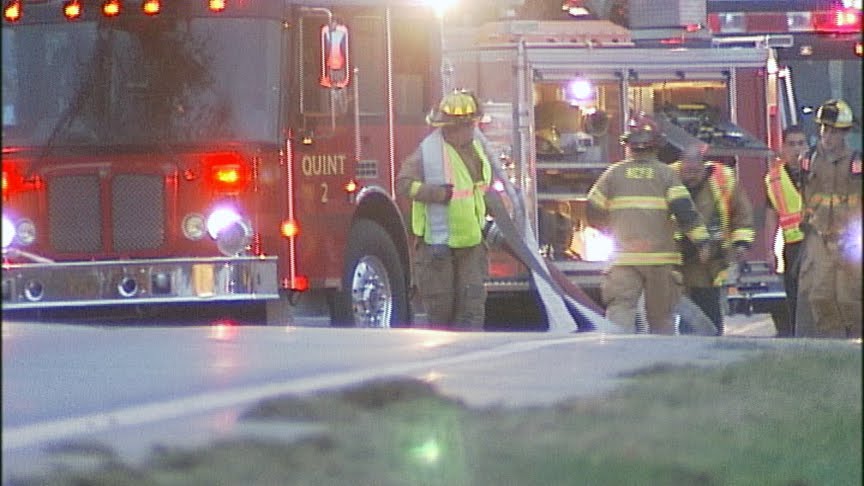
New Carlisle Fire Department's Quint 2 at the scene of a ruptured natural gas line along State Route 235 on Oct. 12, 2011. The line snapped below the shutoff valve, WHIO-TV reported.

Sunday, October 30, 2011

BLACK MONDAY - 1984


They called it Black Monday.

On Aug. 27, 1984, a general alarm fire struck the old Kelsey-Hayes warehouse on West Columbia Street - belching clouds of black smoke and soot across Springfield.

All off-duty firefighters were recalled per general alarm protocol, and Clark County township fire departments sent mutual aid to fill city fire stations.


These photos from the Springfield Daily News are courtesy of retired Lt. Dave Aills of Rescue Company 1.

In the final frame, it appears an ice cream vendor provided refreshments for the spectators.

B&M FIBERGLASS - 1971

Photo: Springfield Fire Division

On Aug. 9, 1971, a fire at the B&M Fiberglass Co. forced Springfield firefighters to "leap for their lives" from the roof. 

"A series of explosions cut them off from their ladders," Captain Calvin Roberds wrote in the 1978 book "From Buckets to Diesels."

The fire at 350 South Fountain Avenue was fueled by resins and solvents and "caused a large number of injuries to firefighters," Roberds wrote.

The blaze also sent a huge plume of smoke over the city.

Firefighters extinguished the flames using master streams and ladder pipes.

Friday, October 28, 2011

WRONG NUMBER

A telephone call for help was wrongly routed to Springfield on March 22, 1952. The caller reported a fire on Massillon Road. That didn't make sense to the dispatcher who politely responded: "This is the Springfield Fire Division." The caller apologized, saying she wanted the Akron Fire Department - 160 miles away. - Associated Press story in St. Petersburg, Florida, Times, March 23, 1952

Thursday, October 20, 2011

CROSS STREETS

An Associated Press story printed in newspapers, including the Free Lance-Star of Fredericksburg, Virginia, suggests Springfield Fire Division dispatchers may have been among the first in the nation - if not the first - to routinely ask callers "What is your nearest cross street?" to pinpoint emergencies. The story was published Nov. 22, 1961.

LINK TO ARTICLE

Wednesday, October 19, 2011

RUNS & WORKERS - PART 4


Photo: Allen County Historical Society

- In 1945, fire struck the Milner Hotel in downtown Lima, claiming two lives and causing many injuries. Firefighters were hampered by poor water supply. Catastrophic hotel fires were all-too-common across the U.S. in the 1940s, prompting safety reforms. Maintenance had been neglected during the Great Depression and World Wat Two. Early 20th Century hotel designs also allowed for rapid fire spread with open stairwells.  

-On Jan. 10, 1982, a major fire "burned through the hospital wing" of the Ohio Masonic Home in Springfield, according to the Associated Press. Firefighters were hampered by intense flames inside and frozen equipment outside. The fire injured 30 people, including four firefighters. The facility has a long history. The cornerstone of Ohio Masonic Home’s original building was placed in 1892.

- On Oct. 13, 1946, a refrigerated railroad freight car smashed into the lobby of the Frances Hotel in downtown Springfield, Ohio. There were no serious injuries. The car was one of three that derailed from a New York Central train, according to an Associated Press report printed in the Telegraph newspaper of Nashua, New Hampshire. The accident caused damage estimated at $100,000 by William Wendl, manager of the hotel, according to an AP dispatch in the Baltimore Sun. A wrecking crane removed the car from the lobby.

- The Victoria Advocate, a newspaper in Texas, printed an Associated Press dispatch on May 7, 1960 from Springfield, Ohio: "
The guest of honor, Raymond Beaty, was left by himself when a fire interrupted his retirement dinner. But Beaty understood. He was a city fireman for 17 years and his farewell dinner was being held in No.6 Engine House when it was interrupted by a general alarm factory fire."

- On the night of Oct. 21-22, 1958, a "fire bug menace" struck the southside of Springfield, according to an Associated Press dispatch published in the Youngstown Vindicator. Fire Chief Willard Compton said fires were set at Springfield South High School, an autobody shop and four garages. "All available policemen and firemen were called," AP said. 

- On June 2, 1873, the shops of the Springfield Agricultural Works went up in flames. The agricultural works - a plant that encompassed 80,000 feet of floor - ``were almost totally destroyed by fire, just when most needed to get out work for the fall trade,'' according to Beer's 1881 history of Clark County. The shops, which manufactured grain drills, cultivators and cider-mills were ``rebuilt at once.' 

- On April 1, 1905, a freight car from the Detroit Southern Railroad jumped the tracks and smashed into the boiler room at the Thomas Stationary Co., causing the Springfield plant's "huge smokestack to tumble to the ground," according to a dispatch printed in The Hudson Independent newspaper of Hudson, Ohio. There were no serious injuries, but some workers "were prevented with difficulty from jumping from the windows," the dispatch said.

- As crews battled a fire at The Peter A. Boggan Co. on Jan. 11, 1932, a floor collapsed ``endangering the lives of the firemen and the chief who were in the basement,'' The Springfield Daily News reported. They escaped without serious injury from the store, which was located at 34 East Main Street, Springfield.

Monday, October 17, 2011

TWIN GENERAL ALARMS - 1925

On May 12, 1925, Springfield was the scene of two general alarm fires - and when the flames were tamed the citizens of Springfield thanked their firefighters with sandwiches and cigars.

 The first blaze occurred at the Springfield Abattoir Co at Mill Run and Buck Creek. (An abattoir is a slaughterhouse.) The fire broke out at 2 p.m. and the flames destroyed the cowshed and barns, according to the Springfield Daily News. The fire also destroyed some livestock.

The second general alarm fire that day broke out at the Brain Lumber Co. at East and Harrison streets. The initial alarm was transmitted at 7:20 p.m. with the general alarm following 10 minutes later, according to the Daily News.

The newspaper reported the fire started when a thick coating of oil on the surface of Mill Run, paralleling the lumber yard, became ignited from an unknown cause.

Flames shot high into the air, and within a few minutes after the first fire company arrived on the scene, the fire had reached one of the buildings of the lumber company and then quickly spread to the others.

From the Mill Run, the flames first spread to a building in which shingles were stored, and numerous other buildings in which finished and rough lumber was stored, were quickly ignited in turn.

The newspaper estimated that the blaze, which was visible from across the city, attracted between 5,000 and 10,000 spectators.

The fire also destroyed three railroad boxcars loaded with lumber.

Firebrands from the lumber company ignited row house roofs along Harrison Street, and firefighters alternately played their hose lines on the lumber yard and the dwellings. Some of the residents turned their garden hoses on the flames.

The citizens of Springfield showed their appreciation to the firemen and ``baskets of sandwiches and kettles of steaming coffee were served to the men as they worked in the cold hours around midnight,'' the Daily News said.

``Boxes of cigars were also passed out to the firemen by the officials of the Brain Co,'' the newspaper said.

Tuesday, September 06, 2011

EMERGENCY SQUAD - 1953


In 1953, the Springfield Fire Division replaced its original emergency squad - a 1949 panel truck - with an International Harvester Metro that permitted more headroom as well as space for additional equipment. IH operated an assembly plant in Springfield.

Friday, January 21, 2011

CROWELL-COLLIER - 2009

Photo: Springfield News-Sun

On Nov. 27, 2009, Springfield firefighters responded to the old Crowell-Collier building where a section of bricks crumbled to the street and sidewalk. There were no injuries.

Thursday, September 09, 2010

FEMALE FIREFIGHTER

Springfield’s first female firefighter retires

By Valerie Lough
Springfield News-Sun
Sept. 8, 2010

 SPRINGFIELD — The first time Diane Arbogast saw a fire engine, it was the day she reported for training at a new job — as a firefighter.

And, all those doo dads on the engine’s pump panel looked pretty intimidating.

“You look at something like that the first time and go ... ‘Ok,’ ” said Arbogast. Twenty-five years later, Arbogast, the first female firefighter at the Springfield Fire Division, retired Wednesday, Sept. 8.

But, as a child, putting out fires wasn’t her dream. She thought she might be a nurse

“I’m not a nurse, but I do take care of people,” she said. Arbogast found her way to the Springfield Fire Division in search of a better job with good benefits.

In other attempts to get a solid job in 1985, some prospective employers told Arbogast flat-out that they preferred to hire a man for the job.

But when she joined the fire division that same year, the climate was much more welcoming, she said. “All the guys were always just super,” she said.

Fellow firefighter John Sells said Arbogast’s nurturing instinct made her a natural in the job. “I think a lot of people will describe her as motherly,” said Sells. “I’ve never seen her get mad.”

Arbogast plans to continue with her second job in the emergency room at Springfield Medical Center and enjoying her eight grandchildren and great grandchild.

 Her voice cracked as she spoke of what she would miss the most about her job — the people she worked with.

“It’s like a big family ... they’ve become my second family,” she said.

Tuesday, July 06, 2010

COUNTRY CLUB - 1922

Fire destroyed the Springfield Country Club on June 14, 1922.

Friday, June 11, 2010

WINTER'S FIRE - 1892

On April 12, 1892, fire gutted Winter's Art Lithographing Co. in Springfield, Ohio - destroying materials printed for the Chicago World's Fair of 1893, according to the next day's The New York Times.

"Before the Fire Department could arrive the entire three stories were enveloped in flames," the Times reported. "The company had contracted for all the World's Fair lithographing, and part of the orginial stones for the World's Fair work were destroyed." 

The fire orginated in a room of oils and inks, "supposedly by spontaneous combustion," and "the heavy machinery was ruined by dropping to the basement," the newspaper reported. It said "the building is a total wreck."

WOODLAWN HALL - 1928

On May 15, 1928, fire swept the Woodlawn Hall womens' dormitory at Wittenberg College, killing Hilda Sipes, 20, of Shelby, Ohio, according to a dispatch from the Associated Press.

Other women were injured jumping from windows early that Tuesday morning, the campus newspaper, The Torch, reported two days later.

Over the years, the tragedy contributed to ghost stories about Woodlawn Hall.

Ms. Sipes died in a lavatory across from her room, No. 11.

Firefighters located her body, clad in a nightgown, in a bathroom "stretched flat on the floor between the bathtub and the wall," said Fire Captain Ed Garrity of the Central Engine House, quoted by the Springfield Daily News.

The fire was discovered by Lilly Myers, house mother for the 20 residents, at about 2 a.m., according to The Torch.

The Associated Press identified three of the injured students as Alice Olde of Detroit, Helen McClain of Troy, Ohio, and Marie Schneider of Indianapolis.

The AP also reported: "More of the girls might have been trapped in bed had not most of them remained awake longer than usual to listen to a midnight serenade of a campus fraternity."

The AP dispatch was published in the May 16, 1928 edition of the Hartford Courant newspaper of Hartford, Connecticut. The headline of the story on page 6 of the newspaper read: "Co-Ed Killed in Dormitory Fire in Ohio."

The AP reporter identified the dormitory as "Woodland Hall."

Wednesday, January 13, 2010

FIREMEN'S PICNIC

Photos: Courtesy of family of Harry Huffman

Springfield, Ohio, firefighters at a picnic and outside a firehouse. Harry Huffman is seated at right in the firehouse photo, courtesy of the Huffman family.

Friday, December 11, 2009

OLD ENGINE 2

Advertisement featuring Springfield Fire Chief Sam Hunter and Engine 2's crew at old Fire Station No. 2, which was closed during the Great Depression of the 1930s.

Wednesday, December 02, 2009

CHIEF HUFFMAN

Harry Huffman was promoted to platoon chief on Jan. 1, 1947. He was appointed to the fire division in 1928 and retired on April 1, 1949.

At the time, the fire division fielded two platoon chiefs, who acted as shift commanders. In the overall chain of command, they answered to the fire chief and the assistant fire chief.

 According to a newspaper article on his retirement, Huffman's pension paid $155 a month or half his regular pay. Huffman was promoted to lieutenant in July 1935 and captain in August 1938.

This photo was provided by the chief's family.

His father and brother were also Springfield firefighters.

OLD ENGINE HOUSE 5

Photo: Cindy Funk via Flickr

Old Fire Station No. 5 on West Main Street, Springfield, Ohio. It housed Engine 5 which was relocated to a new station after the old firehouse closed in 1981.

Wednesday, November 18, 2009

COAL FIRE - 1917

The Springfield Tire Fire always burns in the hometown of "The Simpsons" television series. In 1917, a coal fire smoldered for weeks in Springfield, Ohio. "Springfield firemen resorted to the use of steam shovels to help fight fire in a 100,000 ton coal pile in the Big Four railroad yards, burning since Aug. 1," according to the Mahoning Dispatch of Canfield, Ohio, on Sept. 14, 1917. 

Friday, November 13, 2009

FIRE STATIONS - 1907

Fire Chief — Samuel F. Hunter.

Superintendent of Telegraph — Michael M. Duffy.

Central Steam Fire Company No. 1 — West side of South Fountain Avenue, between Jefferson and Washing ton; H. M. Rankin, captain.

Engine Company No. 2 — East side of North Factory Street, between Columbia and North; C. M. Moffett, captain.

Engine Company No. 4 — Lagonda Avenue, between C, C, C. & St. L. Railroad and Florence; J. Edward Bryant, captain.

Engine Company No. 6 — Southeast corner Mound and Glenn Avenue; E. J. Perkins, captain.

Chemical Engine Company — West side of South Yellow Springs, between Pleasant and Dibert Avenue; William Fanning, captain.

Hook and Ladder Company No. 1 — West side of South Fountain Avenue, between Jefferson and Washington.

Hook and Ladder Company No. 3 — Northwest corner Clifton and Boler; H. T. Evans, captain.

Southern Steam Fire Company No. 3 — Northwest corner Clifton and Boler ; H. T. Evans, captain.

Hose Company No. 4 — East side Lagonda Avenue, between C, C, C. & St. L. Railroad and Florence.

Hose Company No. 5 — South side Main, near Park ; L. L. Metcalf , captain.

Hose Company No. 6 — Southeast corner Mound and Glenn; E. J. Perkins, captain.

Hose Company No. 7 — South side Cecil, between Fountain Avenue and Limestone; Pat H. Lawler, captain.

Hose Company No. 8 — West side South Yellow Springs, between Pleasant and Dibert Avenue; William Fanning, captain.

SOURCE: 20th Century History of Springfield , and Clark County, Ohio and Representative Citizens. Edited and compiled by Hon. William M. Rockel, Springfield, Ohio - 1908.

TWO PLATOONS

On May 1, 1920, Springfield switched to a two-platoon system from continuous duty, placing firefighters "on duty twenty-four hours and off the same length of time — subject to emergency calls at all times," according to a 1922 history of the city by Benjamin Prince.

"The chief is continuously on duty; his entire time is given to the city, and all firemen sleep with their ears attuned to telephone calls, responding as quickly at night as to day time alarms," according to Prince's book.

 "Under the two-platoon system firemen have home privileges impossible under previous conditions ; they have opportunity of knowing their families and sharing in home pleasures appreciated by all of them."

Today, the Fire Division employs a three-platoon system.

Thursday, November 12, 2009

GOOD SAMARITANS - 2007 & 2009

Good Samaritans to the rescue! A neighbor fetched a ladder and saved three people from an apartment fire at 6631 Rita Drive in Enon, Ohio, on Oct. 25, 2007, WHIO-TV reported. Meantime, on Sept. 4, 2009, a passing motorist set up a ladder to save Jonna Buckner from a house fire at 1428 Clifton Ave. in Springfield - and drove off in his truck before she could say thank you, according to the Springfield News-Sun.

Tuesday, November 03, 2009

HAMMA SEMINARY - 1900

On Dec. 28, 1900, fire destroyed Hamma Divinity Hall, a seminary, and low water pressure delayed the firefighters' assault on the flames.

According to an article in the next day's Times newspaper in Washington, D.C., firefighters rescued three students.

All the others were at home for the holidays. The blaze started in a furnace "and by the time the students noticed it the chapel on the first floor was in a blaze," the Times newpaper said. "Efforts to put it out with buckets were fruitless, as the smoke was suffocating."

Underscoring the rapid spread of the flames, the newspaper said Oliver McWilliams, of Montgomery, Pennsylvania, "tried to get out of his room, but was forced back by the smoke."

John Sweeter, of Curlsville, Pennsylvania, "was rescued from a second-story window."

C.A. Hackenburg, of Pittsburgh, "escaped by crawling out on the rear part, where the firemen took him down."

The seminary - located on the grounds of Wittenberg University, then called Wittenberg College - was rebuilt in 1901.

MYERS HALL - 1902


Springfield firefighters saved Myers Hall at Wittenberg University from a prank gone awry in the early 20th Century, according to the Spring 2001 edition of Wittenberg Magazine.

 
The late Rev. Willard Hackenberg, Class of 1901, recalled that two students set fire to coal bins at the rear of the dorm:

 “What a fire that was! Think of the many tons of coal that were burned. ... The Springfield Fire Department came with great force, but because the water pressure was so low, all the firemen could do was protect the dorm.

"They had to allow the coal and the bins to burn, using all the water on hand to keep the very hot flames from reaching the most important building.” The article didn't mention the date of the fire.

Tuesday, July 21, 2009

JEFFERSON SCHOOL - 1928

Jefferson School was destroyed by fire in 1928. It was located McCreight and Garfield. The Trump-Littleton Insurance Agency employed a photographer to document major fires in the City of Springfield as an advertising tool.

Thursday, May 28, 2009

RUNS & WORKERS - PART 3

- On Jan. 8, 1968, a freight train derailed in Snyderville - six miles west of Springfield - and set a family's home ablaze, according to the Associated Press. The accident killed Jason Williams, 47, and injured his wife and three children. Brenda Williams, 17, was credit with saving her younger sister and brother, according to neighbors. A neighbor pulled Jason Williams and wife, Frances, 40, from the flames, according to the AP dispatch. READ MORE

- A search of Google's newspaper archives turned up a brief wire dispatch in The Age, an Australian daily from Nov. 13, 1961. It read:``Three children perished last night when fire swept through their third-floor flat in Springfield, Ohio. Their mother, with her six-month-old son, was visiting friends in a second-floor flat at the time. Firemen found the woman, Mrs. Elisa Duheart, screaming at the door to her blazing flat, attempting in vain to batter it down to rescue her children.''

- On Sept. 7, 1956, an explosion caused the collapse of a new addition to the Donnelsville School, near Springfield, according to the Associated Press. Emma Blackburn, 62, a teacher, suffered rib and wrist fractures. The explosion happened about an hour after school was dismissed for the day, the AP reported. The addition opened four days earlier.

- On Jan. 11, 1976, flames engulfed a house near Springfield, killing an elderly man and his two sisters, according to United Press International. Fire crews located the bodies of John Shaw, 80, Nattie Shaw, 74 and Ruth Shaw, 59 in the debris, according to Hustead fire officials quoted by UPI.

They called it ``America's long hot summer.'' In July 1967, rioting in Detroit led to disturbances in other cities. ``Springfield, Ohio, reported its first racial incidents, with rock throwing and tossing of fire bombs,'' according to the Free-Lance Star of Fredericksburg, Virginia on July 28, 1967. Trouble was also reported in the Ohio cities of Toldeo and Lorain.

- 
SPRINGFIELD, Ohio (UPI) - Firemen say four children playing with matches behind the Lynn Hockenson Co. here accidentally touched off a three alarm fire that swept through the cardboard box producing plant, causing an estimated $40,000 damage. [The Bryan Times, Bryan, Ohio, April 12, 1971]

Friday, May 15, 2009

CHILD CALLS 911

On May 2, 1990, a three-year-old boy named Tyler Wolf dialed 911 after his mother fell unconscious in their home at 817 East McCreight Avenue in Springfield, Ohio.

"He knows that he helped mommy and he called the squad for mommy," said his mother, Lori Wolf, who was quoted by The Dayton Daily News. "We're very proud of him."

The boy's father - employed by a private ambulance company - was at work. The parents taught Tyler how to dial 911.

Following is a transcript - from Dayton Daily News archives - of Tyler, fire dispatchers Rick Williams and David Storer, and police dispatcher Ann Eubanks:

WILLIAMS: "What's wrong, son?"
TYLER: "Mommy fall."
WILLIAMS: "Did mommy fall down?"
TYLER: "Yeah."
WILLIAMS: "What's your name?"
EUBANKS: "Is it Tyler?"
TYLER: "Yeah."
EUBANKS: "How old are you?"
TYLER: "Three."
EUBANKS: "And your mommy's right there and she fell down?"
TYLER: "Yeah."
WILLIAMS: "Is his daddy there?"
TYLER: "No. At work."
WILLIAMS: "Did his mom ask him to call?"
WILLIAMS: "Tyler, you stay here on the phone, OK?"
(IN THE BACKGROUND: Williams then asks fellow fire dispatcher Storer to pick up the call while he sends an engine and emergency squad to the home.)
STORER: "Hi, Tyler. How are you?
WILLIAMS: "Tyler, go ahead and talk to this man for a minute, OK?"
TYLER: "Hi."
STORER: "Hi. We're going to send the emergency squad and an engine out there, and they'll talk to you and take care of your situation, OK?"
TYLER: "No. My dad not going to be here."
STORER: "Why isn't he?"
TYLER: "Because he's working 24."
STORER: "Just your mother's there?"
TYLER: "Yeah. (Unintelligible)."
STORER: "Tyler, stay here on the phone, OK? We want to keep talking to you. How old are you, Tyler? What are you, about seven?"
TYLER: "Mommy! Mommy!"
STORER: "Is your front door unlocked so that the firemen can come in?"
TYLER: "Yeah. No. It's locked."
STORER: "Do you know how to unlock it so that the firemen can help your mom?"
TYLER: "Yeah."
STORER: "OK, because the firemen are on their way up there, OK?"
TYLER: "Mommy! Mommy! Bye."
STORER: "Don't hang up now."
WILLIAMS comes back on the line and says, "Hey, Tyler. What's your mommy doing now?"
TYLER: "Laying down."
WILLIAMS: "Did she hurt her head or something? Did she bump her head?"
TYLER: "No."
STORER comes back on the line and asks, "Are her eyes closed?"
TYLER: "Yeah."
STORER: "OK. We're going to need you to unlock the front door for the firemen, OK?"
TYLER: "OK."
WILLIAMS: "Don't do it right now. We'll stay on the phone with you until the firemen get there, OK? They'll be there in just a little bit. It doesn't take them very long."
TYLER: "Can I put the phone on the chair?"
WILLIAMS: "No. Don't put the phone on the chair right now. You just stand there and hold it. Are you standing there holding the phone?"
TYLER: "No. I'm sitting down."
WILLIAMS: "You're sitting down. OK. Is your last name Wolf?"
TYLER: "Yeah."
WILLIAMS: "Where's your dad? Is he at work?"
TYLER: "Yeah. He's working 24 today. His name Barry Wolf."
WILLIAMS: "His name is Barry Wolf and he's working 24? Do you know where he works? Do you know what company he works at?"
TYLER: "He don't work at company no more. He work at Med Trans."
WILLIAMS: "He works at Med Trans. Hey, Tyler. Go over and open the front. I want you to go over and open the front door, then come get back on the phone."
TYLER: "OK."
(IN THE BACKGROUND: There are three knocks on the door. Tyler asks, "Yeah. Who is it?" He unlocks the door after the firefighters identify themselves and ask him to show them where his mother is. One firefighter then picks up the phone.)
FIREFIGHTER: "Hey Rick. You there?"
WILLIAMS: "Yeah."
FIREFIGHTER: "OK, we're here, bud."
WILLIAMS: "Is it real?"
FIREFIGHTER: "Yeah. Bye."

WESTERN SCHOOL - 1954

On Jan. 4, 1954, a general alarm fire swept the 99-year-old Western Grade School at West Main and Yellow Spring streets.

Eight teachers and 275 pupils were safely evacuated by the time firefighters arrived, demonstrating the value of regular fire drills.

The Springfield Daily News reported that when the alarm sounded teachers ``did not know it was a real fire'' and ``headed their charges out of the building before they realized the building was aflame.''

Coincidentally, an earlier school by the same name was destroyed by fire in February 1858.

Four years later, a fire at the Our Lady of Angels School in Chicago claimed about 100 lives, leading to sweeping changes in school fire safety across the nation.

TREMONT CITYLODD - 1963

Willard Dale Ritenour, a member of the Tremont City Fire Department in Clark County, died in the line of duty on Nov. 4, 1963, according to the Ohio Fire Service Honor Roll. Information regarding the incident is scarce as the Tremont City department disbanded. Ritenour was apparently electrocuted while fighting a grass fire. His name is also listed on an honor roll for Miami Valley firefighters who died in the line of duty.

Friday, March 20, 2009

CHITTENDEN HOTEL - 1893

On Nov. 24, 1893, Springfield firefighters provided mutual aid to the City of Columbus for a blaze that consumed the Chittenden Hotel and Henrietta Opera House. ``The fire takes from Columbus her best theater, her best hotel and a number of flourishing business enterprises,'' the Daily Democrat of Hamilton, Ohio, reported the next day.

Thursday, March 19, 2009

OX TEAM - 1800s

"In the days of Fire Chief Simpson the Simpson Lumber Company horses were used in emergencies saving the city the expense of so many horses. Mr Simpson operated a lumber yard in a central location and one year when there was epizootic among the horses an ox team was used by the fire department the hose cart was too heavy for man power." - Excerpt from Benjamin F. Prince history book, 1922

Tuesday, March 17, 2009

OLD STATION 9

Photo: Springfield News-Sun

Old Fire Station No. 9 at
17 West State St., Springfield, Ohio, closed Jan. 1, 1975
as part of a reorganization of the fire division. It housed Engine 9, Truck 9. The firefighters and equipment were transferred. 

Tuesday, October 28, 2008

GAMEWELL TELEGRAPH

From the 1880s to the 1970s, Springfield was protected by a Gamewell Fire Alarm Telegraph System and red alarm boxes were typically located at street corners as well as some public buildings

When a box was pulled, a spring-loaded wheel transmitted its number and the bells at the city's fire stations clanged out the location.

Firefighters also used Gamewell boxes to request assistance - second alarm, third alarm, etc. - and transmit ``out tap'' signals declaring a fire under control.

On Sept. 23, 1915, Superintendent of Fire Alarm Lawrence Bosley, 45, was fatally injured in fall from a telegraph pole on Main Street, just west of Burnett Road, while doing line maintenance.


List of Telegraph Signals
 Beers' History of Clark County - 1881

5 Warder street, at Buckeye shops.
6 The Western engine house.
7 Corner of High and Spring streets.
8 Central engine house.
9 Corner Lagonda avenue and Nelson street.
12 Corner Monroe and Spring streets.
13 Corner North and Limestone streets.
14 Corner Chestnut avenue and Limestone street.
15 Corner Main and Limestone streets.
16 Corner Ferncliff avenue and Market street.
17 Corner Main and Center streets. 18 Corner Center street and Obenchain alley.
21 At Spangenberger House. East Main street.
23 Corner Lagonda avenue and Main street.
24 Corner York and High streets.
25 Corner Tavlor and Pleasant streets.
26 Corner Linden avenue and Clifton street.
27 Corner Pleasant and East streets.
28 Corner High street and East streets.
29 Corner High and Forrest avenue.
31 Corner Hizer and Limestone streets.
32 Corner Center and Pleasant streets.
34 Corner Factory and Washington streets.
35 Corner Mechanic and Pleasant streets.
41 Corner Yellow Springs and Pleasant streets.
42 Corner Yellow Springs and Main streets.
43 Corner Clifton avenue and Liberty street.
51 Corner North and Plum streets.
52 Carner Main and Light streets.
53 Corner Main and Isabella streets.
61 Champion Machine Company's shops, Monroe street.

Tuesday, August 26, 2008

ELKS CLUB - 1939

Early on Aug. 14, 1939, several firefighters were overcome by smoke at a fire at the Elks Club at 126 West High Street as they searched for the building caretaker. Fire Chief Grover Frock was told the caretaker, Ernest Munz, slept in a storeroom, which The Springfield Daily News described as ``a veritable inferno.'' However, Munz was found in another part of the building sound asleep and ``unaware of the fire,'' according to the News.

Monday, August 25, 2008

BORDEN DAIRY - 1958


On Feb. 20, 1958, a general alarm fire started by a welder's torch gutted the old Borden Dairy at 125 North Fountain Avenue.

``Two minutes after the blaze was reported, thick clouds of brownish yellow smoke poured from the building,'' The Springfield Daily News reported.

Fire Chief Willard Compton credited a dairy employee with preventing the flames from spreading.

Carl Newberry closed a door between the storage department and the cheese department and contained the flames.

Milk cartons coated with paraffin fueled the flames, making for a smokey, slippery mess.

After the fire, the pile of debris outside the dairy rose to the second floor.

Engine Co. 1 had just returned to the Central Engine House from a run to the Hume Hotel when the alarm was transmitted for the dairy, according to a 1978 history of the fire division, ``From Buckets to Diesels'' by Captain Calvin Roberds.