Honoring the Fire and Rescue Service - Springfield, Ohio and Beyond - On Web Since 2005
Fire Buffs promote the general welfare of the fire and rescue service and protect its heritage and history. Famous Fire Buffs through the years include New York Fire Surgeon Harry Archer, Boston Pops Conductor Arthur Fiedler, New York Mayor Fiorello LaGuardia and - legend has it - President George Washington.
Sunday, May 05, 2013
WARDER, MITCHELL & CO - 1867
On Jan. 12, 1867, fire struck the Warder, Mitchell & Company's reaper and mower plant in Springfield. The New York Times published a short dispatch entitled "Destructive Fire in a Manufactory" on Jan. 15 (sent via telegraph from Cincinatti on Jan. 14.) Damage was estimated at $40,000. The property was insured for half that amount.
Friday, April 12, 2013
NEW CARLISLE, NEW DELIVERY
Monday, April 01, 2013
EAST DAYTON - 1957
WRIGHT FIELD - 1945
Saturday, October 13, 2012
OHIO PENITENTIARY - 1930
While the warden braced for a riot, "heroism cropped out in unexpected places," according to a Zanesville newspaper, The Signal. "Liberated convicts gasped fresh air into their lungs, armed themselves with sledge hammers and crowbars and rushed back into the burning tiers."
The blaze - which was apparently started to cover an escape attempt - erupted in the top tier of a cell block along Neil Avenue and spread into other blocks. Built in the late 1800s for 1,500 inmates, the penitentiary housed more than 4,000 on the day of the fire.
The magazine Fire Engineering said: "The large loss of life resulted from delay in opening cells in the doomed sections."
It also said: "At an investigation conducted after the fire, it was learned that no procedure had been drawn for the guards to follow in case of fire. In many instances it was brought out that guards refused to free convicts from cells in the burning sections. Investigators say that if the prisoners were released at once, there would not have been so great a loss of life."
Some inmates won pardons for their acts of heroism, which also led to creation of the Ohio Parole Board in 1931, according to the Ohio Historical Society.
___
Some of the dead were listed as from Springfield and Clark County:
ROBERT BRANNICK
ARCHIE JENKINS
ARCHIE MYERS
CHARLES SHERRICK
THOMAS SHERRICK
ROLLAND J. TAYLOR
FRANK TIMBLIN
EARL YOUNG
Brannick was doing time for possession of liquor. Myers was a burglar. The Sherricks were locked up for robbery. Taylor passed bad checks. Timblin was convicted of larceny. Young stole an auto.
____
Following is from a report on the fire by the Ohio Inspection Bureau:
A gang of convicts engaged in construction work on the new concrete cell block, I and K, had discontinued operations about 4:00 P.M. for the day, or about an hour and a half before the fire was discovered, and the occupants of G and H cell blocks had been locked in for the night.
Just who actually first observed the fire is unknown, but it was presumably seen by several at about the same time.
It is thought that a guard in the tower on the outside wall which is a short distance beyond the north end of the building, where the fire originated, was among the first and called to someone on the street below who pulled fire alarm Box 261 at the head of Dublin Ave., as the first call was received by the fire department at 5:39 P.M. from this location.
The first fire apparatus to arrive was on the ground in not to exceed two minutes after the call was sent in, and was promptly admitted at the wagon stockade gate at the corner of Dennison and West Spring Sts., from where it proceeded into the grounds.
The first equipment to arrive consisted of one truck and three engine companies and was under the command of Assistant Chief C. W. Ogborn.
The first company to go into action connected to the hydrant at the northwest corner of the new auditorium and directed a stream from a turret nozzle into the north window of I and K cell block.
However, the heavy iron grilling in the window caused the stream to be so broken up as to be rendered ineffective and this line was eventually cut off.
In the meantime, a second pumper had connected to the hydrant directly north of the auditorium and a line was carried through the east door of the cell house directly opposite the passageway between G and H and I and K cells blocks and a stream directed toward the north end of the building.
By this time, the fire was burning fiercely and the entire roof over I and K blocks had fallen in.
It was also at this point that some of the prisoners from the outside, apparently, driven to desperation by the plight of their fellow convicts locked in the cells of G and H blocks, and whom the guards had failed to release, wrested the hose from the firemen and attempted to carry it into the ranges themselves.
However, they were finally persuaded to leave the firemen to proceed uninterrupted with their work.
During this time, also, another line had been run from the second pumper, carried to the foot of the cell block, and two small lines attached to a Siamese, which were carried the entire length of the fifth and sixth ranges, being turned into the various cells to extinguish the fires in the bedding and cell furnishings.
At the same time, firemen and guards aided by convicts armed with axes and sledge hammers, proceeded to knock bars and locks from the cell doors and remove the dead and dying from their cells, carrying them down the stairs or lowering them by means of ropes through holes cut in the outer netting to the floor below, and to the outside.
Following the first alarm at 5:39, fire department officials, seeing the seriousness of the situation upon their arrival, immediately sent in additional alarms, the second going in at 5:42, the third at 5:48, and a fourth at 6:03, the second and third alarms each calling out three engines and one truck company, and the fourth, four engines and two truck companies, or almost all the available equipment in the city, a total of thirteen pumpers and five truck companies.
There were approximately 140 fireman normally responding on the equipment called into service, although this number was considerably supplemented by response of members of the off-shift, so that the total number of firemen working was actually greater than this.
The third pumper to go into action connected to the hydrant on West Spring Street, directly opposite the penitentiary entrance, the lines being carried over the roof of the front office and up a ladder to the top of the front dormitory, as the fire had spread rapidly through the roof structure above G and H cell blocks, eaten its way over the top of the temporary frame partition between the dormitory and the cell block and was creeping into the concealed roof space over the dormitory.
However, the quick and effective action on the part of the department in cutting holes in this roof and directing streams into the concealed space, as well as bringing a hose line in through the barred windows of the south wall on the third range, prevented the fire from spreading into that section.
Lines by this time had also been carried up ladders to the roof from the north side of the dormitory.
Two additional pumpers connected to the two hydrants directly northeast of the Cotton Mill and another to the hydrant north of the kitchen.
There was also a pumper operating in Dennison Avenue through a line over the wall and across the wagon stockade.
Still another machine set up at the next hydrant north, but was not brought into action.
At the height of the fire there were eight pumpers, mostly of 1000-gallons capacity, in actual operation, supplying twenty-three streams directed on all sides of the burning building, and by about 9:00 o’clock, the fire was brought well under control.
When the first companies arrived on the scene, the fire was raging fiercely among the wooden concrete forms at the top of incompleted cell blocks I and K, which had not yet been poured and in the debris of the roof which had already fallen in on this section.
The intense heat and smoke from this section had also been driven, aided by a fair breeze from the north, under the concrete roof slab above G and H cell blocks, the heat being of sufficient intensity to ignite the bedding, chairs, etc., in the sixth range and to burn and suffocate the inmates, and the heaviest casualties occurred in this range.
The heat and smoke that invaded the fifth range, while severe, was less than in the tier above, so that a higher percentage of the men in this range survived.
A few, but not many, casualties occurred in the ranges below, principally from suffocation.
While the main fire was at its height, outside of the first difficulty experienced by the firemen in having their hose taken away, and while the bodies were being removed, many of the convicts assisted and there was no trouble.
However, some later on became unruly, menaced the firemen, and cut the hose from the pumper north of the kitchen.
Axes and minor equipment were broken or stolen, rocks were thrown at the apparatus, and one group of convicts attempted to set fire to the large gasoline tank supply wagon of the department by igniting piles of blankets which had been placed under the truck.
The driver, although warned by the convicts not to do so, jumped on the truck and removed it from the grounds.
Friday, October 12, 2012
RUNS & WORKERS - PART 6
"Some Like It Hot" -- Street scene from Dayton, Ohio; outside the Ohio Follies Theatre in the late 1950s or early 1960s.
Crash at Wright-Patterson military airfield, between Springfield and Dayton, on Oct. 30, 1935
Thursday, August 23, 2012
'COVERED WAGON'
ATTACK PUMPER
Engine 1, a 1959 Mack, was dubbed the "Attack Pumper." It's pictured here it is in semi-retirement as Reserve Engine 10. The rig was painted safety green after it was scorched at a fire in the late 1970s. The Attack Pumper responded to all working fires in the city with a crew of four or five men following the Jan. 1, 1975 reorganization of the fire division. In some city's such units were known a "Flying Squad."
4's & 5's
LIGHT AND AIR
Light and air unit operated by volunteers of Box 27 Associates in Springfield in the 1970s and 1980s. It was a converted fire division ladder truck.
RESERVE TRUCK
Monday, April 23, 2012
HOLDER OIL - 2012
Photos courtesy of Spingfield Fire Lt. Dave Allis
April 19, 2012 was a dark day in Clark County, Ohio.
"More than 50 agencies responded — including every fire department in Clark County — to the fire at the R.D. Holder Oil Co., 2219 Folk Ream Road," according to the Dayton Daily News.
The Springfield Fire Rescue Division sent Hazmat 1, operated jointly with the county.
"The blaze produced flames that shot 200 feet up, black smoke could be seen as far away as Dayton and Butler County, and the plume even showed up on weather radar," the newspaper reported
Tuesday, March 27, 2012
'AIRCRAFT CARRIER'
The unique rig started life as a 1966 Peter Pirsch Aerial 1 HC Tractor and was converted into a heavy rescue, still with maneuvered with the original tiller.
A new tractor was added at some point.
Based at Fire Station No. 1 in central Springfield, the hybrid was known for a bumpy ride - especially for the tillerman - as the removal of the aerial ladder lessened its weight.
Before its conversion, the rig operated as Truck 6. It was retired in the 1990s and replaced with a rescue engine.
Photos courtesy of the Springfield Fire-Rescue Division.
Sunday, March 11, 2012
RADIO SIGNALS

Signal 3A - Working fire can be handled with current assignment
Monday, January 23, 2012
WRIGHT PATTERSON - 1961
On Nov. 21, 1961, fire swept a sprawling office building at Wright Paterson Air Force Base, killing two base firefighters.
Station Chief Dale Kelcher and Firefighter William Collins were last seen entering Building 262-A, headquarters of the Air Force Logistics Command, which took fire at just before midnight Thanksgiving Eve. A backdraft trapped them.
The blaze "reduced a three-story frame building covering nearly the area of a football field to a pile of smoldering charcoal,” according to a newspaper account.
Firefighters resorted to ground and aerial master streams to battle the blaze and called for mutual aid from neighboring communities.
At a November 2018 memorial, Major Tyler Johnson, commander, 788th Civil Engineer Squadron, said: "They looked danger in the eye and they ran into the flames."
Four days after Kelcher and Collins died, another major fire gutted a building at the air base, between Dayton and Springfield. There were no serious injuries in that blaze.
Two other Wright-Patterson firefighters died in the line of duty. Frank A. Smith perished fighting a fire at a motor pool in 1932 and Harold “Sparky” Sparks suffered a heart attack in 2009, according to Air Force records.
RUNS & WORKERS - PART 5
- On May 6, 1895, The New York Times published a brief dispatch from Springfield entitled "AN OHIO TOWN ON FIRE; New-Carlisle Threatened with Destruction -- Opera House and Other Buildings Burning." New Carlisle requested assistance from Springfield's fire department after the fire broke out May 5, the dispatch said. William Francis Stockstill, 1850-1922, built the theater and moved to Dayton when it "aburned to the ground," according to a family history posted on the web.
- On Dec. 12, 1906, flames broke out at St. Bernard Church on Lagonda Avenue. The fire "for a time threatened the entire structure, but fortunately it was confined to the organ," according to a 1935 history of the parish. "It was much disputed what caused the fire, but it was thought that a candle was left lighted in repairing the organ. The organ was immediately replaced by a larger one."
- On April 4, 1978, a freight train plowed into the Skelgas Co. propane plant in Springfield - forcing the evacuation of homes and businesses by police and firefighters. The derailment was caused by a flatbed truck that collided with the Detroit, Toledo & Ironton train at a grade crossing. The truck was hauling steel rolls. According to news accounts, a quantity of propane gas was released from the Skelgas plant, but there was no fire or explosion, and no one was seriously injured.
On Dec. 12, 1906, flames broke out at St. Bernard Church on Lagonda Avenue. The fire "for a time threatened the entire structure, but fortunately it was confined to the organ," according to a 1935 history of the parish. "It was much disputed what caused the fire, but it was thought that a candle was left lighted in repairing the organ. The organ was immediately replaced by a larger one."
Sunday, January 22, 2012
FRIDAY THE 13TH
Friday, January 20, 2012
LOGAN CHILDREN'S HOME - 1907

FIRE ATTACKS CHILDREN'S HOME.
Bellefontaine, O., May 15. -- The Logan County Children's Home was totally destroyed by fire. All of the 42 children were saved.The building was a magnificient three-story brick structure, built nearly 20 years ago, but was without fire protection of any kind.
[Van Wert Daily Bulletin Ohio May 15, 1907]
DAYTON OPERA HOUSE - 1869

LOSS BETWEEN $600,000 AND $800,000
HEARTRENDING SCENE.
Dayton, May 16, 1869.
At one o'clock this morning Turner's Opera House, in this city took fire and was entirely destroyed. The building was occupied by McKEE, WOODWARD & WEEKLY, wholesale grocers; BLACK & FOX, wholesale china and queensware; GROVER & BAKER'S Machine Company, a large restaurant and billiard rooms. Nothing was saved but a few sewing machines.
The fine residences east of the Opera House, on First street, of J. SCHWAB, JOEL ESTABROOK and A. KUHERS, were also destroyed. The fire also communicated to the buildings south, on Main street, owned by M. OHMER, which were entirely destroyed, including the large furniture establishment of MR. OHMER and the grocery store of SARDMIER & BROTHER.
HERMAN SARDMIER, of the latter firm, was endeavoring to save some of his goods, when a portion of the wall fell, crushing him to the floor. His brother and several others endeavored to extricate him, but it was impossible. He lived in this condition for a while, when another crash came, burying him in the ruins. His wife and family were present, but no human power could save him.
The scene was heartrending. The loss is estimated at between $600,000 and $800,000, and the insurance about $100,000. It is supposed to be the work of an incendiary. The Opera House was one of the finest in the West, and was owned by J. M. and W. M. TURNER, whose whole loss will be about $250,000 over and above an insurance of $48,000.
[New York Herald - May 17, 1869]
Thursday, November 24, 2011
XENIA TORNADO - 1974


On April 3, 1974, Xenia, Ohio was ground zero for a killer tornado packing winds up to 300 mph - a disaster that took 34 lives and injured more than 1,000 others.
Many of the dead were youngsters.
Hundreds of homes and businesses - even Xenia High School - were destroyed by the twister that crashed into town at 4:40 p.m. - one of about 150 spawned during a 24-hour outbreak across the Midwest and South.
The city operated two fire stations, employing 36 paid firefighters.
"The homes of many firemen and policemen were damaged (13 homes were destroyed) and yet all the off-duty men were back to work within half an hour," the magazine Fire Engineering reported.
The tornado damaged the city's No. 2 fire station, depositing debris blocking the apparatus ramp. The engine company's crew, in turn, responded on foot.
In major emergencies, ``the normal procedure for firemen on a recall is to report to Station 1. However, because it was impossible to travel by car as the tornado damage extended from one end of town to the other, most men started working in the areas nearest their homes," Fire Engineering said.
With lines of communications down neighboring fire and police departments ordered their personnel to the scene.
"The devastation has been likened to World War II saturation bombing," the Xenia Gazette reported. "Xenia was virtually wiped off the map ... At 1 a.m. today there still were distraught parents walking anxiously through the downtown area looking for their children."
The newspaper described some of the ruins:
"All that could be found of what was once the Mr. Donut Shop on N. Allison Avenue were the stools, standing alone like mushrooms, with the building nowhere in sight.
"Across the street, the Kroehler Mfg. Co., exemplified the terrific impact. A tractor-trailer rig was blown approximately 100 yards onto the roof of the Community Lanes Bowling Alley across the street.
"To the east, the wreckage of the Penn-Central freight train gained most attention. It had been lifted from the tracks and thrown into the Kroger Store parking lot and onto a nearby used car lot. Several fatalities are said connected with this. The Kroger store was obliterated."
It continued:
"Undoubtedly the greatest destruction was in the Arrowhead subdivision where block after block of small brick homes were flattened in an area about halfway between Bellbrook Avenue and W. Second Street. In many instances it was almost impossible to determine houses ever existed."
Aggravating matters, gas and water lines snapped citywide.
Firefighter Charles Beason told the Cleveland Plain Dealer newspaper that "I could see a roof go up, start spiraling, then just explode into thousands of pieces" as he peered through binoculars.
Fortunately Greene Memorial Hospital was spared, and WHIO-TV weatherman Gil Whitney was credited with saving lives for alerting viewers to the tornado's deadly path toward Arrowhead.
Ten days later, tragedy struck again when a fire at a store used as a temporary shelter killed two relief workers, members of the Ohio Air National Guard.
In the aftermath, bumper stickers appeared declaring "Xenia Lives!" and within a year, 80 percent of the homes and half the businesses had been rebuilt, according to Ohio History Central.
On the tenth anniversary of the disaster, Harold Horton, principal and assistant pastor of the First Church of the Nazarene, recalled: "People were crying, just lying in the streets." Horton spoke in an interview with United Press International.
On May 14, 1886, a tornado killed about 30 people, with houses "picked up as if they were egg shells and carried in this mad rush of water until they were dashed to pieces against bridge abutments and whatever they might come in contact with," the Daily Advocate of Newark, Ohio, reported.
Wednesday, November 02, 2011
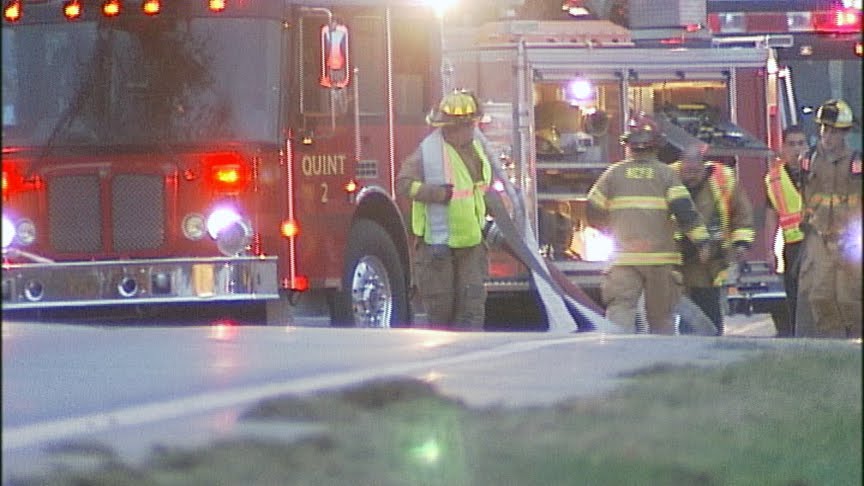
NEW CARLISLE - 2011
Sunday, October 30, 2011
BLACK MONDAY - 1984
On Aug. 27, 1984, a general alarm fire struck the old Kelsey-Hayes warehouse on West Columbia Street - belching clouds of black smoke and soot across Springfield.
All off-duty firefighters were recalled per general alarm protocol, and Clark County township fire departments sent mutual aid to fill city fire stations.
These photos from the Springfield Daily News are courtesy of retired Lt. Dave Aills of Rescue Company 1.
In the final frame, it appears an ice cream vendor provided refreshments for the spectators.
B&M FIBERGLASS - 1971
On Aug. 9, 1971, a fire at the B&M Fiberglass Co. forced Springfield firefighters to "leap for their lives" from the roof.
"A series of explosions cut them off from their ladders," Captain Calvin Roberds wrote in the 1978 book "From Buckets to Diesels."
The fire at 350 South Fountain Avenue was fueled by resins and solvents and "caused a large number of injuries to firefighters," Roberds wrote.
The blaze also sent a huge plume of smoke over the city.
Firefighters extinguished the flames using master streams and ladder pipes.